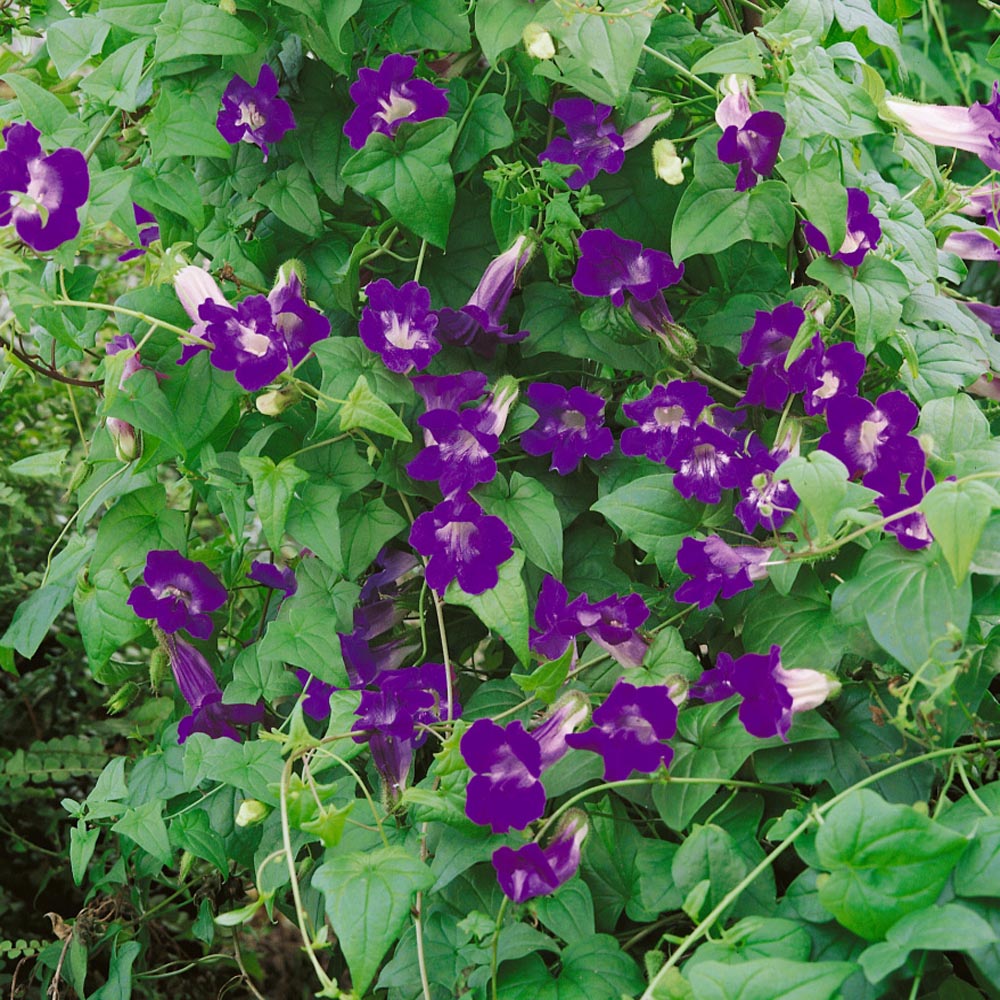
Add this spectacular vine to your garden for a fabulous display! Snapdragon Vine, also known as twining or Climbing Snapdragon, produces attractive lime green leaves and masses of stunning, violet colored, trumpet-shaped flowers from summer until frost season begins.
Annual.
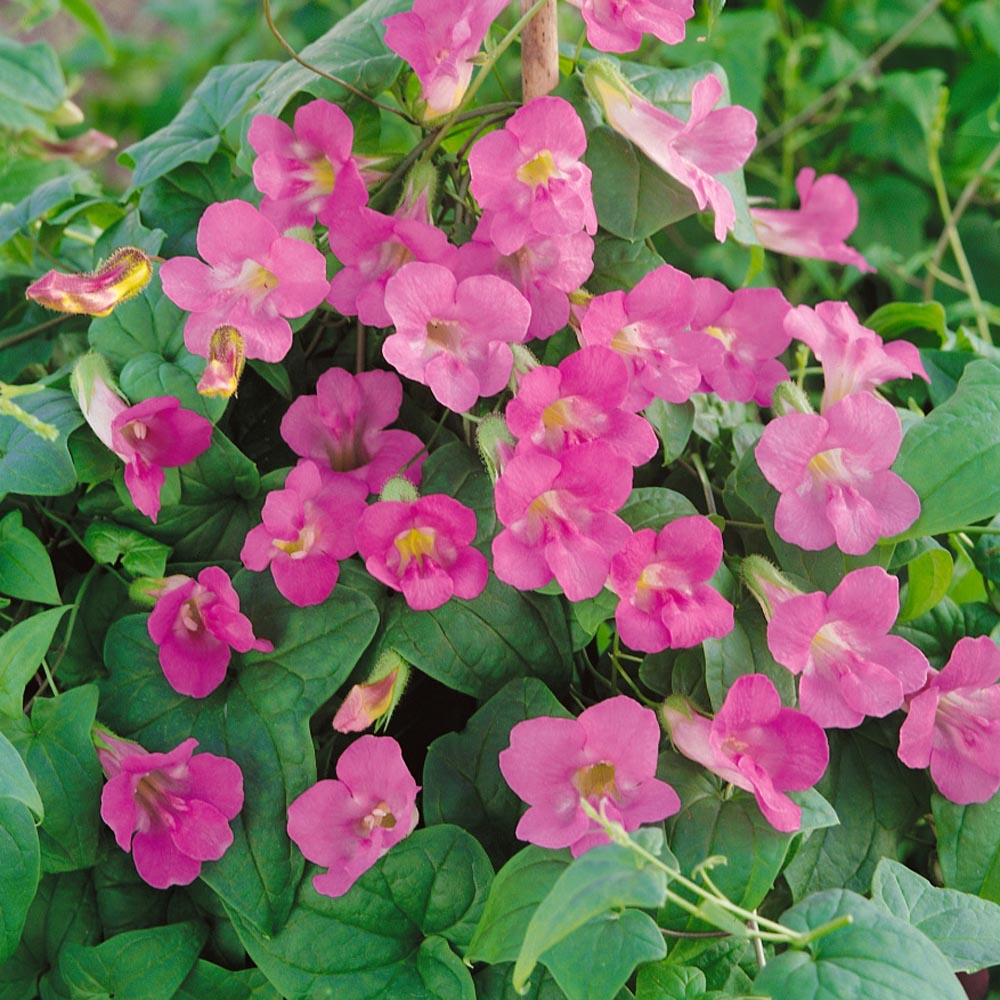
LET687 Rose Climbing Snapdragon ( Asarina scandens )
A member of the snapdragon family, Asarina Scandens is a vine that is delicate in appearance but can easily climb 10 feet. The foliage has soft emerald green, arrow-shaped leaves that are covered with tubular, trumpet-shaped blooms that are deep rose in color. The blooms cover the vine from summer until frost. Plant Climbing Snapdragon seeds in full sun to partial shade. Asarina performs well in hot and cool weather; however, it will only grow as a perennial in frost free zones so it is considered a tender-perennial. Climbing Snapdragon vines can provide an elegant screen for a sunny porch, beautify a garden fence, or give a stunning focal point in the landscape when grown on a trellis.
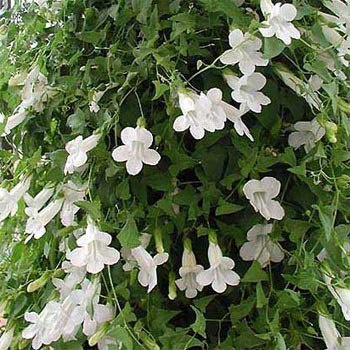
JB149 White Climbing Snapdragon ( Asarina scandens )
Asarina seeds are easy to grow, and soon the garden will have a gorgeous vertical addition! This Climbing Snapdragon, has large 2-inch trumpet-shaped white flowers that begin blooming in early summer and continues until frost. Small emerald green leaves are covered in a mass of delicate snow white blooms on twining stems that reach a height of 10 feet in full to partial shade. Asarina Scandens grows well in containers and baskets, and will also grow happily climbing up a trellis.
Climbing Snapdragon grows fast and easily. Despite how delicate it appears, it is quite tough. Cut Asarina back if it gets shabby and it will bounce right back. Plant the seeds in rich soil with average moisture. It is considered to be a tender-perennial, and in frost free zones, it will be evergreen. With a frost, Asarina vine will die back, but it may have new shoots in the spring. Give it a top dressing of compost once a year in early spring.
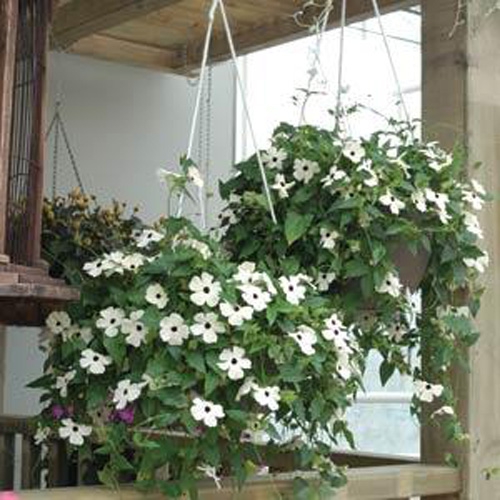
LET189 Sunrise White Thunbergia ( Thunbergia Alata )
Gardeners fall in love with Thunbergia vine. Easily established from Thunbergia seeds, this annual is commonly called Black-Eyed Susan Vine. This white Black Eyed Susan vine is very quick to bloom, offers a super-long season of color, and has a classic color pattern that complements everything in the garden! The blooms reach about 1 1/2 inches in diameter when open wide. The petals are white, surrounding a bold black eye on most blooms. The blooms are profuse smothering the vine over a long bloom season clear up until frost.
White Thunbergia vines grows best in full sun. They needs average, well-drained soil. Plant seedlings 3 inches away from supports. Netting or strings make good trellis material. Solid fencing or large posts will need trellis material for the vine to climb. Space plants 8 - 12 inches apart. Pinch the tips of young Black-Eyed Susan plants to encourage branching. In areas of no frost, white Thunbergia vine will grow as a perennial. In colder climates, grow it as an annual, sowing the Thunbergia seeds each year. If grown in a container, Thunbergia Black Eyed Susan vine can be wintered indoors in a bright, sunny window.
It is recommended to soak the Black-eyed Susan vine seeds over night in tepid water. Following the soaking, sow Thunbergia seeds outdoors after the last frost in prepared seed bed. Or, to get a jump start on the growing season, sow Thunbergia Alata seeds indoors 6 - 8 weeks before outdoor planting. Thunbergia flower seeds germinate better in darkness.
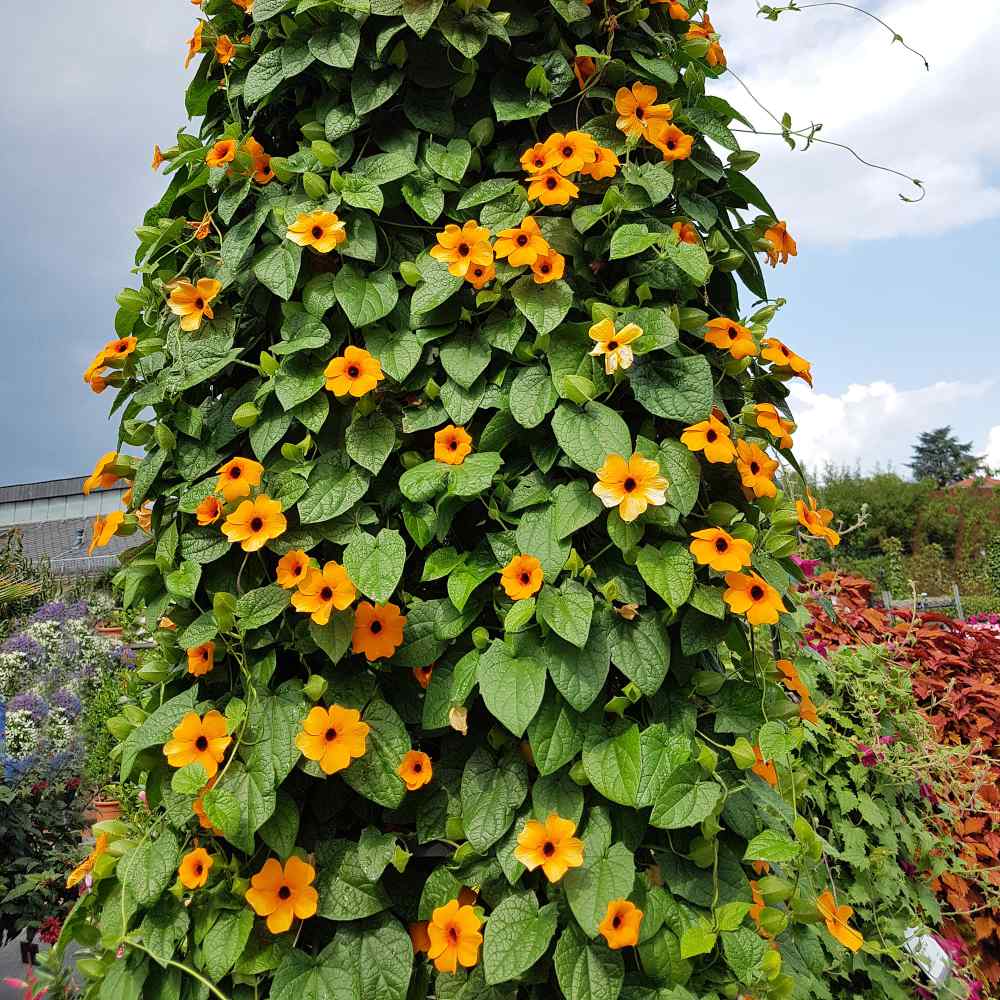
LET262 Sunrise Orange Thunbergia ( Thunbergia Alata )
The orange Black Eyed Susan vine features 1 - 2 inch orange blooms, many with black eyes, against large, heart-shaped foliage. It's a fast climber, and it will adorn a rustic gate, mailbox, flagpole base, or trellis with a twining vine, lush foliage and masses of blooms. Thunbergia orange vines makes wonderful privacy screens if they are grown at the base of chain-link fencing.
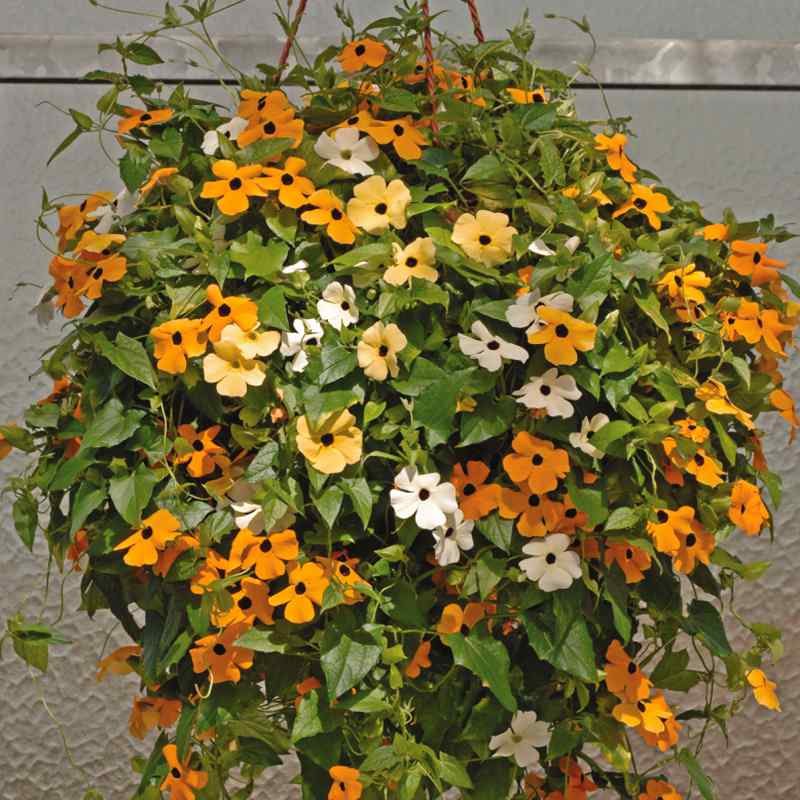
LET190 Sunrise Mix Thunbergia ( Thunbergia Alata Mix )
Gardeners fall in love with Thunbergia vine. Easily established from Thunbergia seeds, this annual is commonly called Black-Eyed Susan Vine. This Black Eyed Susan vine is very quick to bloom, offers a super-long season of color, and has a classic color pattern that complements everything in the garden! The blooms reach about 1 1/2 inches in diameter when open wide. The petals are a mix of white, yellow and orange, surrounding a bold black eye on most blooms. The blooms are profuse smothering the vine over a long bloom season clear up until frost.
Thunbergia vines grows best in full sun. They needs average, well-drained soil. Plant seedlings 3 inches away from supports. Netting or strings make good trellis material. Solid fencing or large posts will need trellis material for the vine to climb. Space plants 8 - 12 inches apart. Pinch the tips of young Black-Eyed Susan plants to encourage branching. In areas of no frost, Thunbergia vines will grow as a perennial. In colder climates, grow it as an annual, sowing the Thunbergia seeds each year. If grown in a container, Thunbergia Black Eyed Susan vine can be wintered indoors in a bright, sunny window.
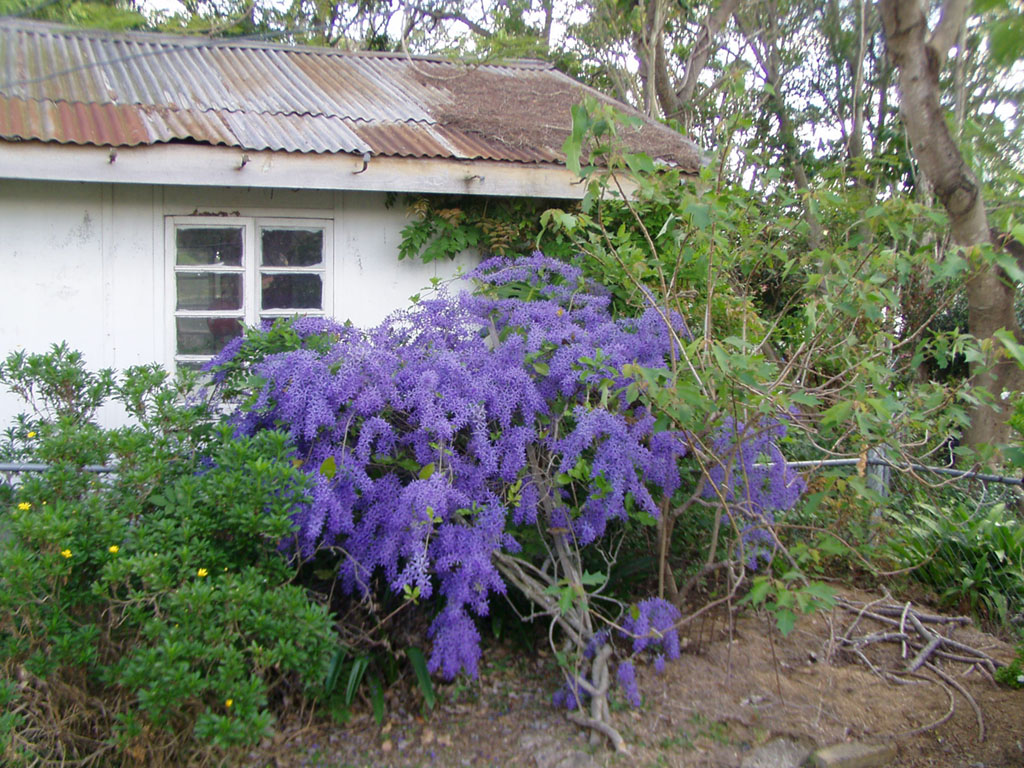
SF333 Queens Wreath ( Petrea volubilis )
Queen's Wreath is a glorious vine from Mexico that blooms long tresses of lavender blue blossoms that resemble tiny orchids. It is one of the most distinct and beautiful of the cultivated climbers. It looks somewhat similar to a tropical Wisteria. It is a fast-growing woody vine with a grey bark, a strong climber, and will attain great height and cover a considerable area if left unpruned.
An evergreen clambering and twining vine that in Central America can grow to great heights with support (25-40 feet) but in cultivation is more often seen as a espalier subject or a smaller vine though plants to 20 feet have been noted in Southern California.
It has long elliptic shaped leaves to 8 inches long that are dark green above and lighter below and rough to the touch like sandpaper. Several times a year ( spring through early summer and again fall into winter ) appear the 1 foot long terminal raceme of flowers, resembling that of wisteria.
The tubular blue flowers only last a few days but the larger and more showy bluish purple calyces remain, fading first to blue and finally to a pale gray color. The dark green foliage, with its gritty texture, acts as a foil to the pale calyces, so that the floral display appears as pale stars on a dark background. The flowers are attractive to bees, butterflies and hummingbirds and useful in flower arrangements but cut only at the base of the raceme as the flowers wilt if part of the woody vine is left attached.
Plant this beautiful vine in full sun or light shade in a well-drained soil and give regular irrigation throughout the warmer months of the year.
Said to be cold hardy ( without dying )to upper 20's. Zone is probably 8b-11.
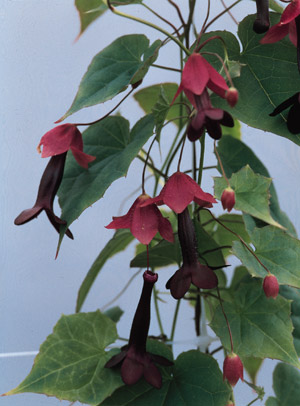
TWT280 Purple Rain ( Rhodochiton )
Grow Purple Rain for an exotic vine that will have everyone's attention! It has heart-shaped leaves and dark purple bell-shaped flowers that dangle from thread-like stems. Bell Vine uses include baskets where it will cascade over the edges and look stunning or give it a trellis where it will grow with support up to 120 inches in height.
Purple Bells needs rich, well-drained soil and full sun to partial shade although it prefers afternoon shade in hotter climates. Purple Bells bloom from late spring to late fall. Annual
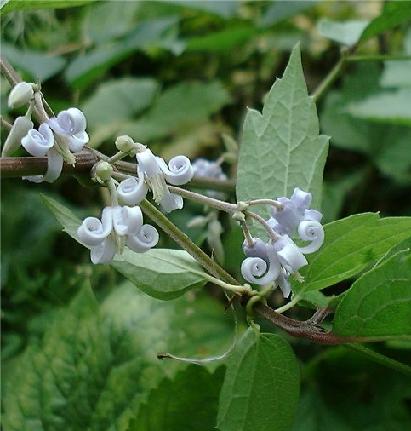
W213 Japanese Blue Bell Clematis ( Clematis stans )
New! Japanese origin vine, soft blue bell-shaped flowers. Climbs up to 8 ft tall, hardy for zones 4-9.
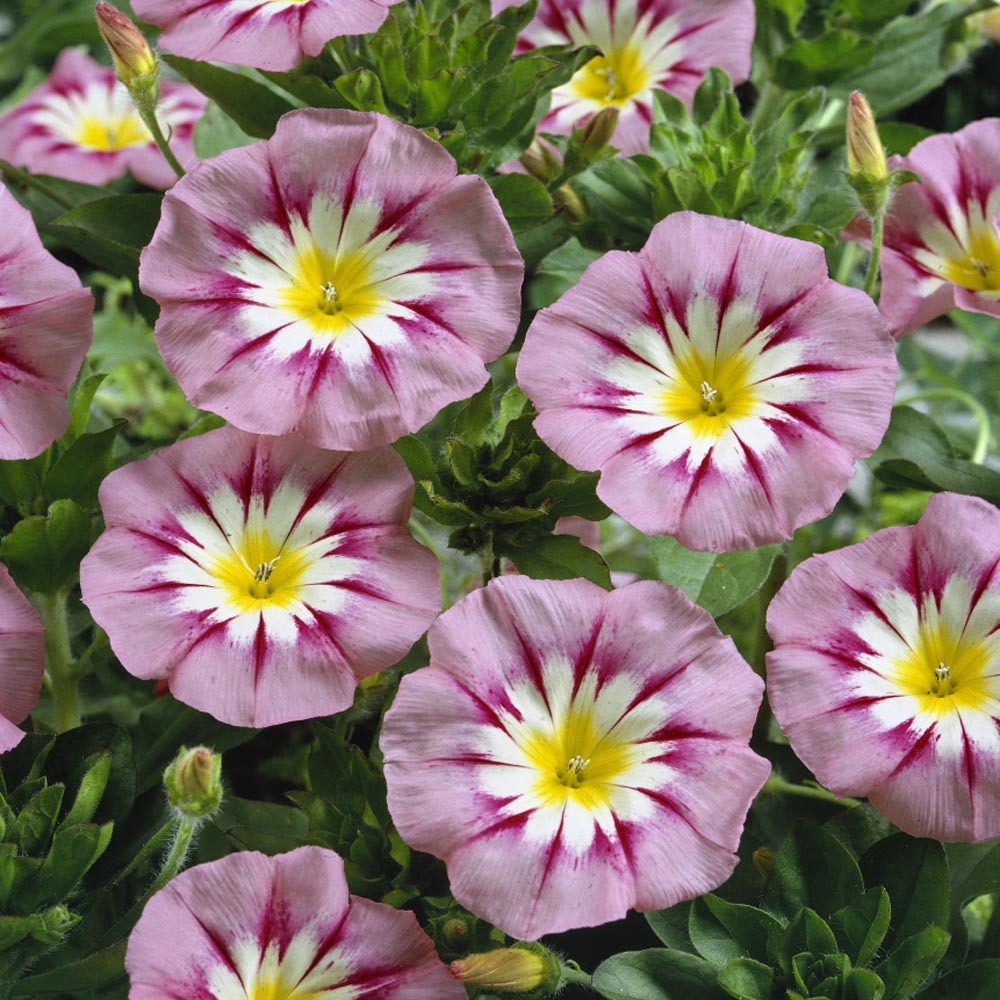
SF339 Dwarf Morning Glory Rose Ensign
Convolvulus Tricolor. Grow Dwarf Morning Glories easily and quickly from flower seeds. Convolvulus tricolor has a mounding habit, and is well-suited as a flower bed plant where the 2 inch trumpet-shaped flowers will happily shine. Dwarf morning glory uses also include containers, baskets and window boxes. Rose Ensign features blooms that are tri-colored with rose and a yellow throat surrounded by a white edge. Plant seeds after soaking the seeds overnight.
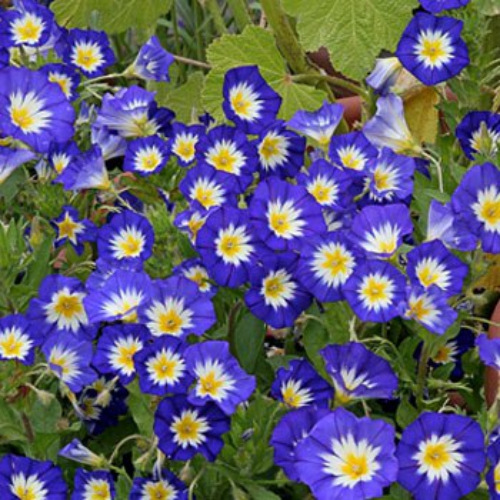
LET290 Dwarf Morning Glory Royal Ensign
Convolvulus Tricolor. Grow this deep blue mounding variety from seeds for colorful, hardy, compact bedding plants. Convolvulus Tricolor Ensign is also perfect for containers or window boxes. Royal Ensign features 2 inch trumpet-shaped blooms that are tri-colored with deep blue, a yellow throat and surrounded by a white edge. Blue Dwarf morning glory is a delight to see spilling over the edges of a planter box.
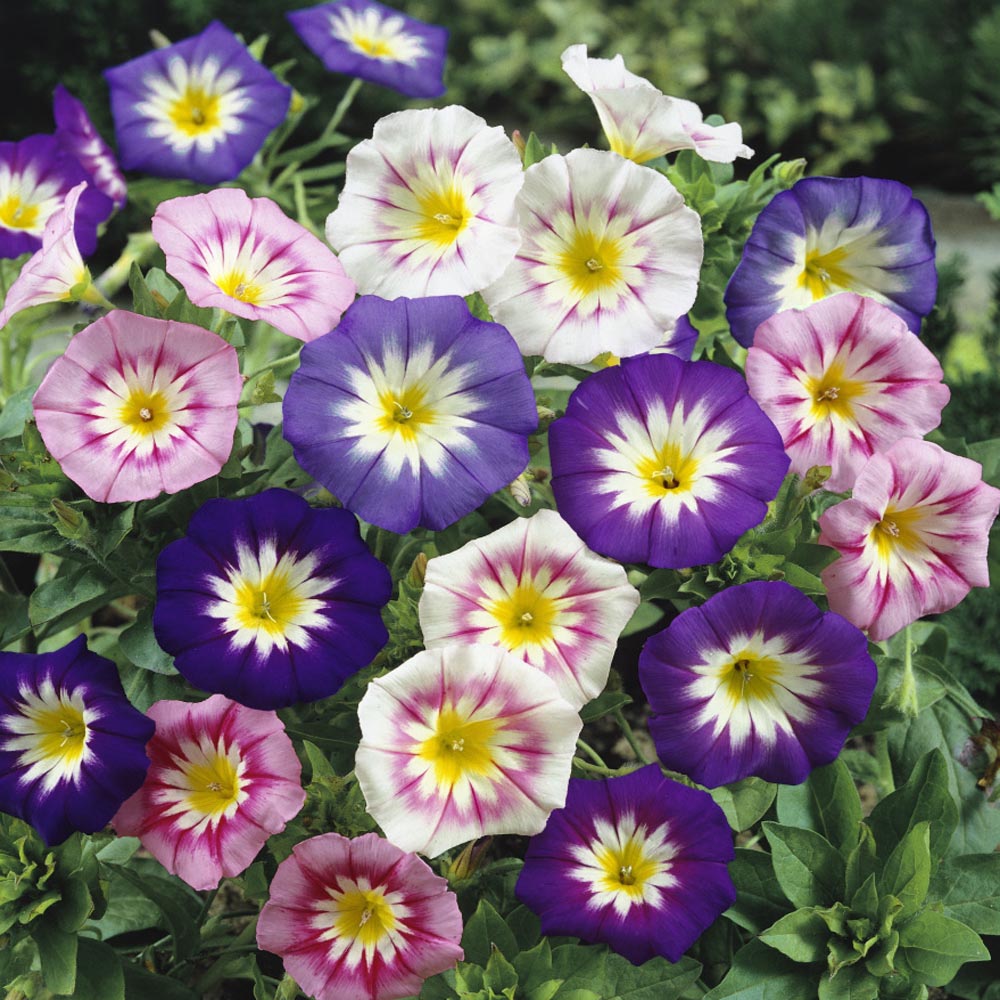
JB238 Dwarf Morning Glory Ensign Mix
Grow this mounding variety from seeds for colorful, hardy, compact bedding plants. In addition to the flower bed, use the plant in containers or window boxes. This mix features 2 inch trumpet-shaped blooms that are tri-colored. The shades range from indigo blue, lavender, red or rose with a white band and yellow throat. They are prolific bloomers and will bloom until frost. They are also liberal self-seeders, dropping their own flower seeds for next year's display.
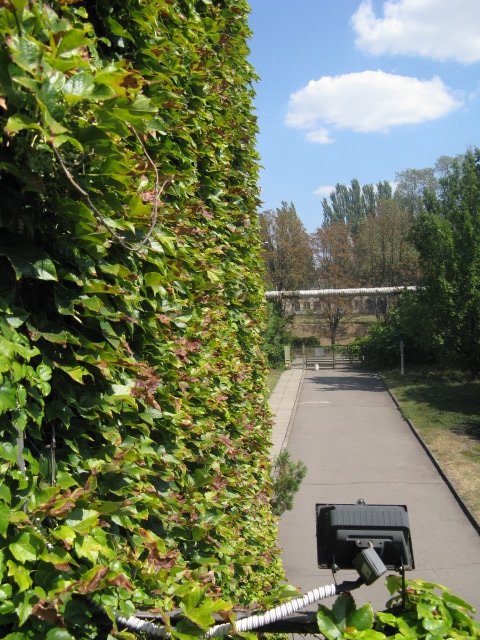
TRZ089 Boston Ivy ( Parthenocissus tricuspidata )
The famous ivy of the North that grows just about anywhere. Attractive glossy green foliage on a climbing perennial vine that will cover just about anything. It is the plant from which the term "Ivy League" derives, growing on numerous upscale campuses.
You can easily grow Boston ivy as houseplants that will climb on an indoor trellis or other structure. This is easily accomplished, as Boston ivy plants readily climb by tendrils with adhesive disks.
Boston Ivy is a sensible alternative to ivy, a perennial climbing vine that is gentler on masonry and an even more vigorous grower (its reach can top 30 feet at maturity). It is a well-behaved climber, with vines that won’t destroy your masonry or cause cracks in the facade of your house. It is best suited for zones 4-8.
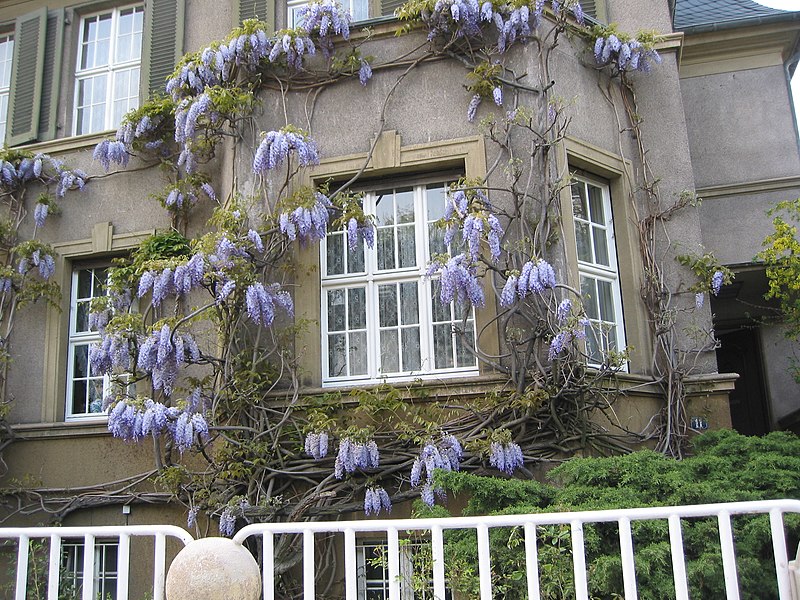
FA48 Blue Wisteria Vine ( Wisteria sinensis )
This perennial climber is prized for it's beautiful fragrant flowers, twining stems, beautiful foliage and vigorous climbing habit.
Wisteria sinensis, commonly called Chinese wisteria, is a deciduous vine that grows vigorously to 25’ or more and features 6-12” long racemes of mildly-fragrant, pea-like, blue-violet flowers in May when the foliage is just beginning to expand. Flowers bloom somewhat simultaneously on the racemes thus producing a dramatic floral display. Flowers give way to pendant, velvety, bean-like seed pods (4-6” long) which ripen in autumn and may persist into winter. Compound, odd-pinnate, deep green leaves (each leaf typically with 7-13 leaflets).
In contrast to the very similar Japanese wisteria (Wisteria floribunda), Chinese wisteria differs by counterclockwise twining, fewer leaflets per leaf, shorter flowering racemes of less fragrant flowers that bloom simultaneously on each raceme and blue violet flower color. Over time, the stems of this vine become twisted, trunk-like and massive.
You should plan ahead when planting this vine. It must be sited and trained only on sturdy structures which will be able to support the considerable weight of the mature vine. This is an excellent vine for large, sturdy, freestanding arbors, pergolas, posts, trellises, fences or terrace walls, and can be particularly effective when grown near or above patios where the flowers can be enjoyed in season. May also be trained as a specimen shrub or tree.
Hardy to zone 5 and easily grown.
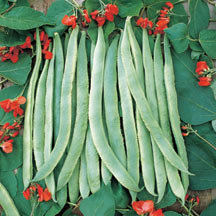
TCB063 Scarlet Runner
Old-fashioned favorite perfect for the kitchen garden. Multi-use bean with edible blooms, tender young pods and beautiful shell/dry beans. Bright scarlet flowers have a sweet, fresh taste and are attractive to hummingbirds.
Prolific ornamental variety with light green, flat pods 12-16" long which are fine flavored when young and tender. Large shiny black and purple mottled seeds are tasty as a shell or dried bean. 80 days.
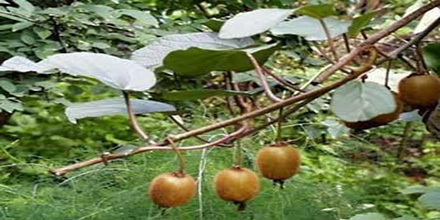
D8509 Kiwi Fruit ( Actindia chinensis )
Cold hardy to zone 4. Kiwis are vigorous vines. They cannot
support their own weight and will spread up to 30 feet. They
require strong support such as trellis, arbor, or fence. In
nature, they grow up into trees. Training to the south side of
a building is excellent for the small planting. Kiwi vines are
heavy feeders and like their roots to be in warm soil. A mature
kiwi vine can produce 200 pounds of fruit.
Kiwis require special training and pruning to produce good
crops. When planted, the vines should be pruned back to 4 or 5
buds. From these a main stem should be selected and staked to
grow to the top of the arbor or trellis, usually 6-7’
high. The trellis should be strong to support the heavy future
fruit loads.
Kiwis are beautiful vines. Their vigorous spring growth is a
spectacular sight. Excellent for a privacy screen, they will
rapidly cover a fence and with support will cover a wall or
steep slope. Kiwis grow in a manner similar to grapes but more
rapidly. They are very high in Vitamin C. (Ten times as much as
lemons.) They are excellent for eating fresh and are a tasty
addition to salads and desserts. Ice cream, pies, jam and wine
are other ways to use kiwis.
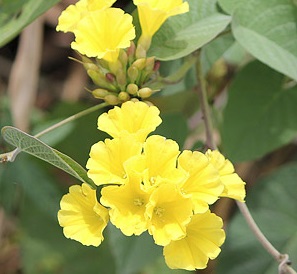
SF250 Hogvine ( Merremia umbellata )
This relative of the Woodrose family is a perennial vine that is extremely hard to find in the US. Growing to 15 feet and showing off these beautiful sprays of cascading yellow flowers throughout the summer make this vine a keeper. Attracts birds, butterflies and bees. Hardy in zones 8-11. Especially nice to grow over a trellis or privacy fence and will grow in full sun or part shade, producing more blossoms in full sun. It is well suited for pot culture in warm greenhouses. Perennial. Widely used for it's medicinal properties in India.
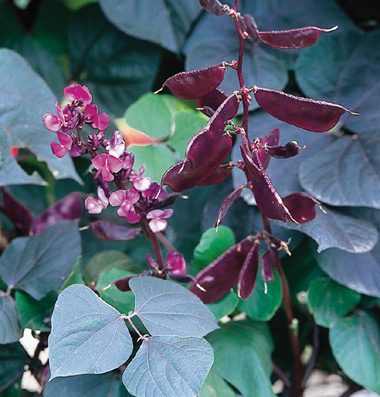
SF152 Ruby Moon ( Dolichos Lab-Lab purpureus )
Annual. A showy climber with green and wine-colored foliage, fragrant lilac-rose flowers and shiny, magenta 2-3 inch pods.
Blooms and pods can used for cutting. Twining growth to 10-20 feet tall.
Perfect for trellises, arbors, walls or fences. Perennial in zones 9 and 10, it can be grown as an annual everywhere.
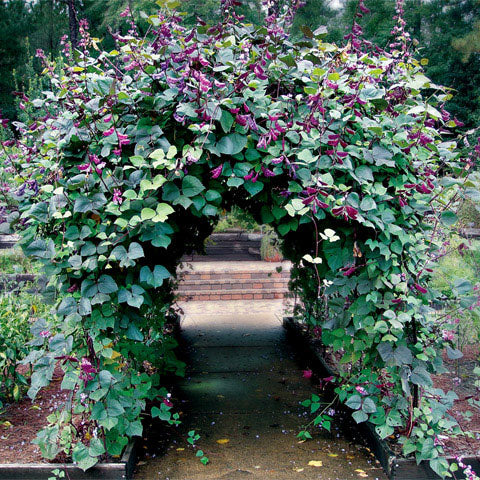
D9606 Hyacinth Bean ( Dolichos Lab-Lab )
Annual. Lablab bean is a twining vine with leaflets in threes and showy
bright purple flowers and pods. In frost-free areas the vine
becomes woody and can reach more than 30' in length. In zones 9
and colder, the vine remains herbaceous and rarely exceeds 10'.
The leaflets are purplish-green, broad-oval or triangular in
shape and 3-6" long. The flowers are pea-like, a rich,
brilliant purple, and arranged in loose clusters on long stems
that extend above the foliage. The pods are just as showy as
the flowers. They are flat and curved, about 3" long and bright
purple.
Easy to grow in poor, acidic to alkaline soils. Lablab beans
take 90-150 days from sowing to maturity. Immature pods can be
picked sooner. Needs full sun for best growth. Requires
well-drained soil. Once established, lablab bean is drought
tolerant, more so than most beans.
Young immature pods are cooked and eaten like green beans
(older pods may need to be de-stringed). They have a strong,
beany flavor and some people like to mix them with other beans
or green vegetables. Unfortunately, the purple color disappears
during cooking. Young leaves are eaten raw in salads and older
leaves are cooked like spinach. Flowers are eaten raw or
steamed. The large starchy root tubers can be boiled and baked.
The immature seeds can be boiled and eaten like any shelly
bean. Dried seeds should be boiled in two changes of water
before eating since they contain toxic levels of cyanogenic
glucosides. In Asia the mature seeds are made into tofu and
fermented for tempeh. They are also used as bean sprouts.
Lablab bean is a good choice for a quick screen on a trellis or
fence. It grows fast, has beautiful, fragrant flowers that
attract butterflies and hummingbirds, and it even produces
edible leaves, flowers, pods, seeds and roots. Each summer I
train a vine or two of lablab up the clothes line pole just for
the color and fragrance.
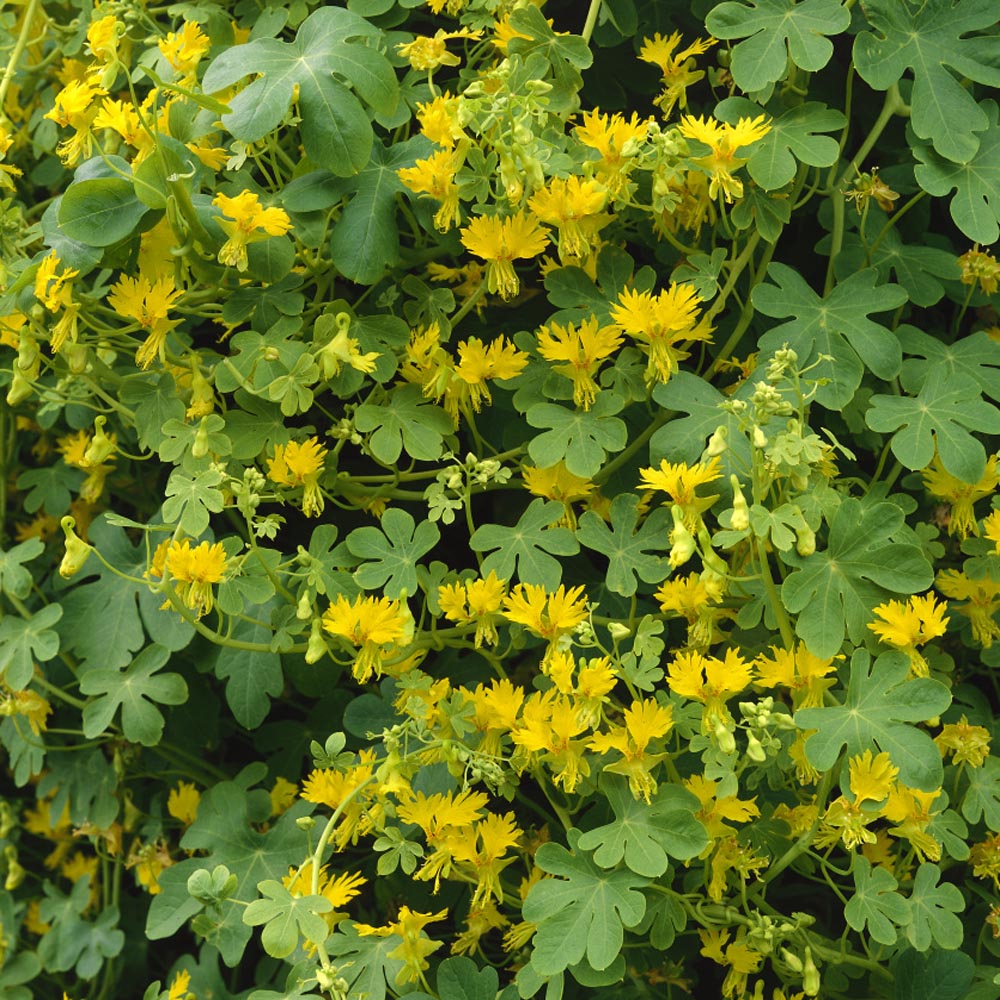
D8575 Canary Bird Vine ( Tropaeolum
peregrinum )
Known as Canary Creeper Vine or Canary Bird Vine, this beautiful and delicate vine will climb a structure. Provide a string, and it will climb a fence or porch railing nicely. The Canary Creeper flower resembles the feather wings of a canary. Nasturtium Canary Vine adds an exotic look to the landscape. Canary Creeper is normally treated as an annual in zone 8; however during mild years, it does winter over. As long as there is not a hard frost, Canary Creeper will grow as a perennial climbing vine.
Canary Creeper seeds should be soaked in water overnight to help break down the tough outer seed coat. Sow the Nasturium seeds directly outside and cover the flower seed 1/4 inch with soil. Canary Creeper care includes watering deeply, but letting the roots dry out in-between waterings. There is no need to either fertilize or deadhead the vine. The Canary Bird flowers, young leaves, and fruit are edible and, like its cousin the nasturtium, has the same peppery taste.
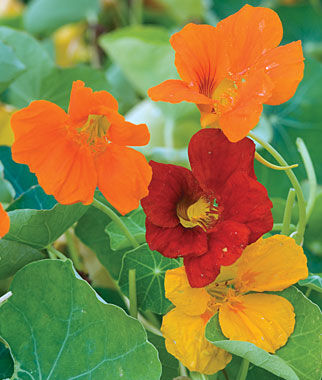
This semi-trailing Nasturtium wanders 1m (36") and more. Large, fragrant, double and semi-double flowers come in a beautiful range of colours. Encourage it to climb by tying. Sow Glorious Gleam nasturtium seeds to fill in a large area quickly. Glorious Gleam Nasturtium seeds can be direct sown in the late spring or early summer. Try them in hanging baskets or along a rock wall. All Nasturtiums tend to self sow, but they are tender plants and easy to control. The leaves, flowers, and seeds of this nasturtium are edible, and the flowers bring a rich visual pop to salads and smart drinks. An AAS Winner in 1935.
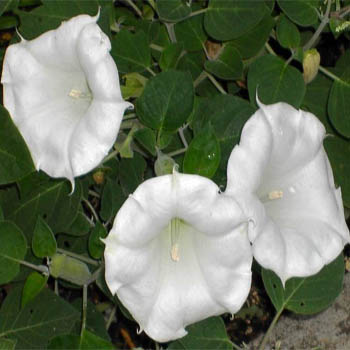
D9804 Giant Moonflower( Ipomea alba var )
Annual. The moonflower is a vigorous twining vine that is very fast growing in really hot weather. It is a tender tropical perennial but is now seeing popular use as an annual vine in colder areas.
This close relative of the morning glory has similar heart shaped leaves that are a rich green and 4-8 inches long. They provide a beautiful backdrop for the spectacular moonflowers.
This vine also known as the evening glory as its buds open in late afternoon and last only until morning's light transforms them into a limp shriveled mass.
Moonflower makes up for the brief lifespans of individual flowers by producing quantities of the big blossoms throughout the summer. These are held on a stem that bears several buds simultaneously, not all of which bloom the same night. The long 4 inch buds are also very attractive especially in the hours just before the flower opens.
And what a fabulous flower the moon vine produces! They are fluted funnels sculpted in purest alabaster white. About the diameter of a saucer measuring 5-6 inches across.
As if the moonflower was not already enchanting enough, it also has a delightful fragrance to complement its beauty and perfume warm summer nights.
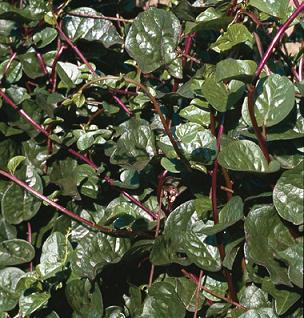
FB159 Red Malabar Spinach ( Basella rubra v Rubra )
Annual. Charming twining climber, dark red-olive leaf, purple red stem, pink flowers, vine for large pots or beds or as vegetable.
Also known as Ceylon spinach, vine spinach or Malabar nightshade. It is a climbing perennial plant, mostly cultivated as an annual vegetable against a support in home gardens but in some areas as a vine like market vegetable without staking. Malabar spinach is not a true spinach (Spinacia oleracea L., chenopodiaceae), but its leaves, which form on a vine, resemble spinach, and are used in the same way. The plant is a native of the East Indies, and found its way to the New World from China. It has spread throughout the tropical world and it is one of the best tropical spinach widely adapted to a variety of soils and climates. It is particularly abundant in India, Malaysia, and the Philippines, but it is also seen throughout tropical Africa, the Caribbean, and tropical South America.
Malabar spinach has thick tender stems and the leaves are almost circular to ovate, alternate, and short petioled. The flowers, borne on axillary spikes or branching peduncles are bisexual and inconspicuous. The fruits are fleshy and purplish black and the juice is sometimes used as a dye.
The succulent young and mature leaves, and the stems are eaten. The most common method of cooking is as a pot herb, mixed with stew or other vegetables. The leaves have mild flavor. Malabar spinach is a good source of vitamins A and C, calcium, and iron.
Malabar spinach is a perennial that tends to extend itself over time. Seeds can be sown directly or vines may be established directly from stem cuttings. These need a little shade on transplanting, but root readily. Malabar spinach can thrive under conditions of moderate soil fertility, but is quite responsive to nitrogen fertilizer. Can be harvested at 57 days after planting.
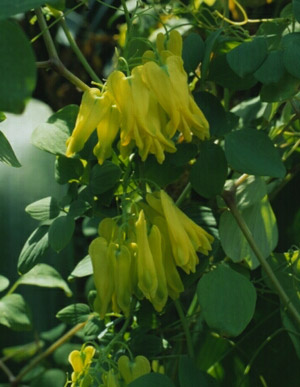
LET797 Golden Tears ( Dicentra scandens )
Bright yellow heart-shaped flowers bloom in April or May; bloom continues off and on
throughout the season. This climbing perennial can reach 3 feet high and wide. The
species is native to the Himalayas.
Grow in fertile, well-drained, slightly alkaline soil in part shade and allow to self-sow.
Provide a strong support for its tender weaving tendrils. May be grown as an annual in
cooler climates.
A hardy perennial, hardy to zone 3.
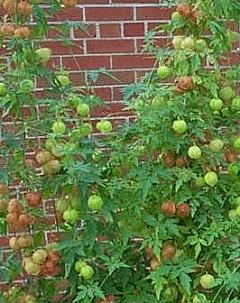
D9935 Heartseed ( Cardiospermum halicacabum )
Balloon Vine is a woody climbing plant with tendrils that grab structures like a trellis or fence, and the vine produces small white flowers which after time forms the large ornamental seed pods that resemble balloons. Cardiospermum vine can climb up to 10 feet in no time forming its remarkable inflated seed pods. The seed pods change color over time from green to red as the plant matures.
The seeds are very unique with a hard shell of dark brown to black, and each seed has a perfect cream colored heart. The flower seed gives the plant another one of its common names, Heartseed Vine. Another common name for Cardiospermum is Love in a Puff Vine.
Also known as Kanphuti. A climbing annual common throughout India. Leaves are mixed in castor oil to treat stiff limbs, rheumatism and lumbago. Root has diaphoretic, diuretic and laxative properties.
Leaf juice is used for earache. Cooked and eaten in India and Africa. Decorative black seeds with cute heart-shaped white faces are used for necklaces.
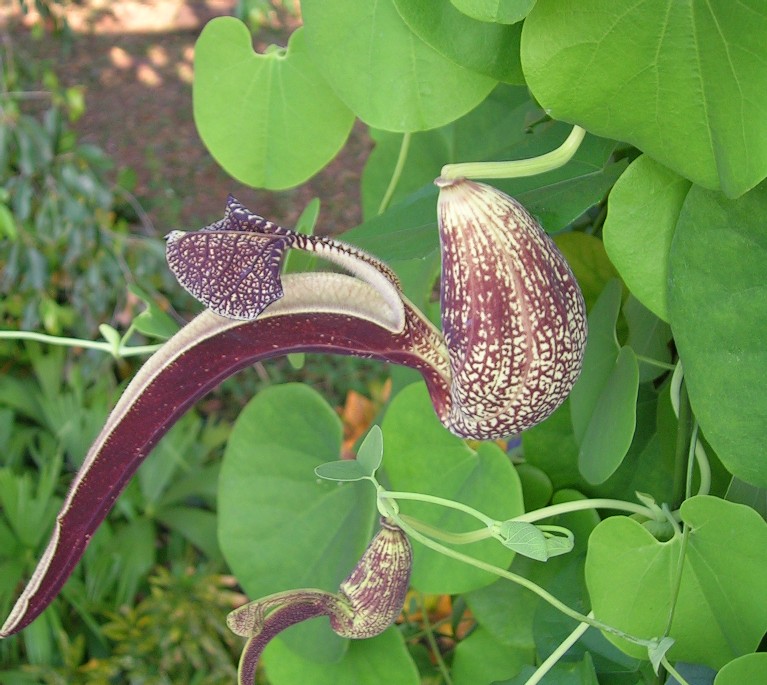
TWT277 Gaping Dutchman's Pipe ( Aristolochia ringens )
An evergreen vine in warm zones, the tops will be killed to the ground in freezing weather but usually return in the spring in zone 8.
It likes to grow in a light and airy place, but not in direct sunlight. The plant can endure short periods of drought and still look fresh. From spring to summer, the vine produces quantities of 4-5 inch long fragrant flowers scattered among the drooping leaves. The flowers trap insect pollinators and facilitate cross pollination. Highly entertaining flowers; a vigorous grower, the outrageous blooms are patterned with a network of burgundy, red, and purple over a creamy-yellow background. The fruit is a capsule, green maturing to brown and opening to release many fertile seeds. Prune back shoots after flowering.
Features: A vine with beautiful dark green heart shaped leaves and paler underneath. These are about 3 inches long by 1-1/2 inch wide and grow closely together to create a dense mass of foliage. These slender woody stems twine gracefully in tight coils around fence wire and other supports lifting itself to heights of 6 to 30 feet. Stems age to woody.
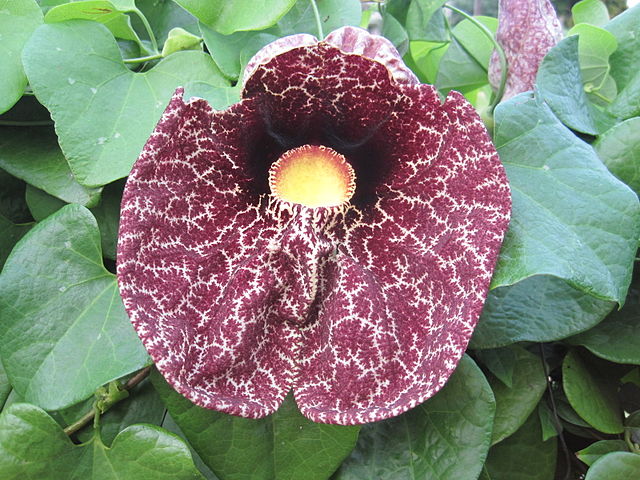
LET252 Elegant Dutchman's Pipe ( Aristolochia littoralis )
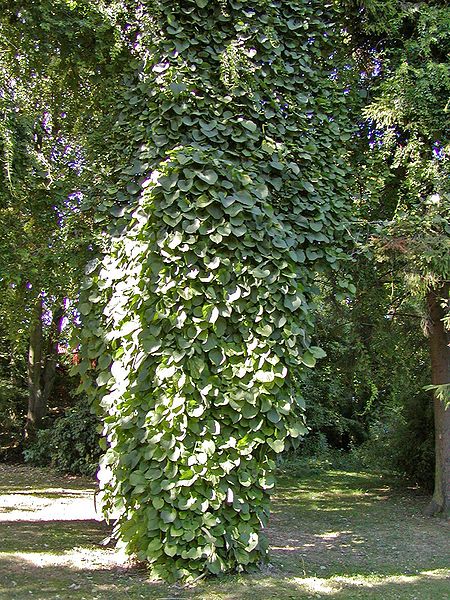
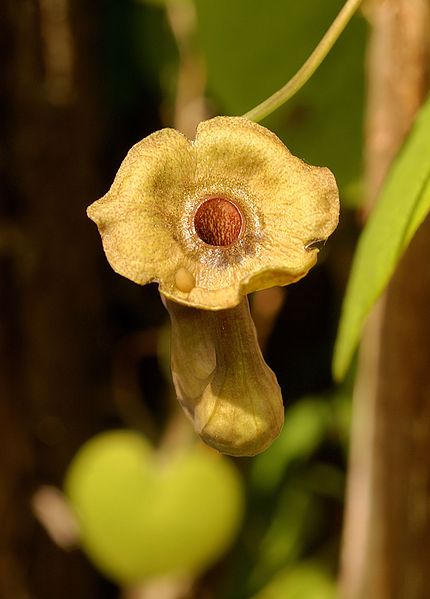
A climbing vine that can reach about 10 to 15 feet in length. The slender stems are woody and the leaves are bright green, forming a dense attractive foliage. Flowers are heart-shaped, greenish yellow with intricate purplish-brown markings. These unusual flowers are about 3 inches long, grow solitary in the leaf axils and resemble Sherlock Holmes's pipe (hence the common name of "Dutchman's pipe"). The inner surface of the flared mouth is completely purplish-brown. The flowering period extends through all summer. This plant can be invasive in Florida and California, we do not ship these seeds to these states.
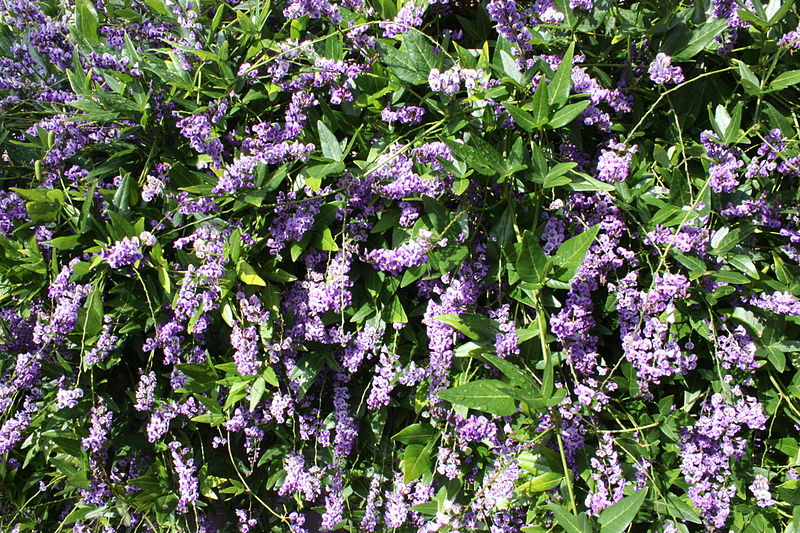
LET255 Australian Wisteria ( Hardenbergia comptoniana )
Ideal flat ground cover, can be used to scramble over fences, garages & pergolas. Thrives in moist well drained soil in a sunny, open position. A species of flowering plant in the pea family, Fabaceae, native to Western Australia. A twining vine, it produces purple flowers in the spring. It is found on sand dunes and sand plains, and in open forest, on sand- or clay-based soils. It is readily cultivated in the garden, where it does best in a part-shaded position.
It has been in cultivation for many years and is widely grown both in Australia and overseas. It has proven to be very hardy in a wide range of climates and most reasonably drained soils. It will grow in sunny or lightly shaded locations. It is usually more vigorous than H.violacea and should not be allowed to grow over smaller shrubs. It grows well on a strong support such as a fence or trellis. These are beautiful plants, especially when trained to grow on trellises and pergolas and allowed to drape down over sitting areas of the garden. Mature plants are cold hardy to about 28 degrees.
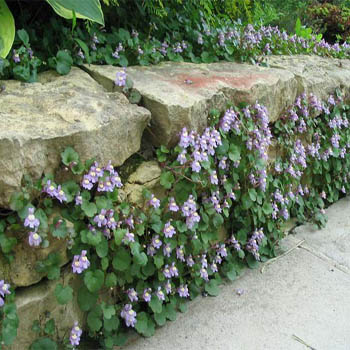
IP251 Kenilworth Ivy ( Cymbalaria muralis )
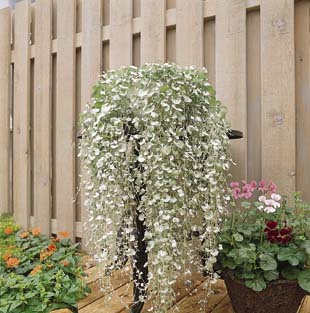
Annual/Perennial inside. With scalloped leaves, and pretty lilac colored blooms, Kenilworth Ivy makes a wonderful ground cover or hanging basket plant.
It performs well even in full shade, and it loves to cascade down a stone wall or spill over the sides of containers. The plant also makes charming hanging baskets. This trailing vine takes very little maintenance except for regular waterings, and being cut back and deadheaded before setting seeds.
It is a prolific self-sower, spreading its seeds all over the garden. To keep it more contained, deadheading is helpful. Kenilworth Ivy makes a very nice flowering ground cover plant. Ground cover plant that is also ideal for rockery. Perennial, hardy for zones 5-9, grows 4 inches tall.
Sow seeds indoors 10 weeks before the last frost is expected. Use starter trays, sow the ground cover seeds on the surface of sterile soil, gently pressing the seed into the soil.
Do not cover the seeds. They need light to germinate. After danger of frost has passed, transplant the young ground cover plants into the garden.
Average germination time is 14-24 days.
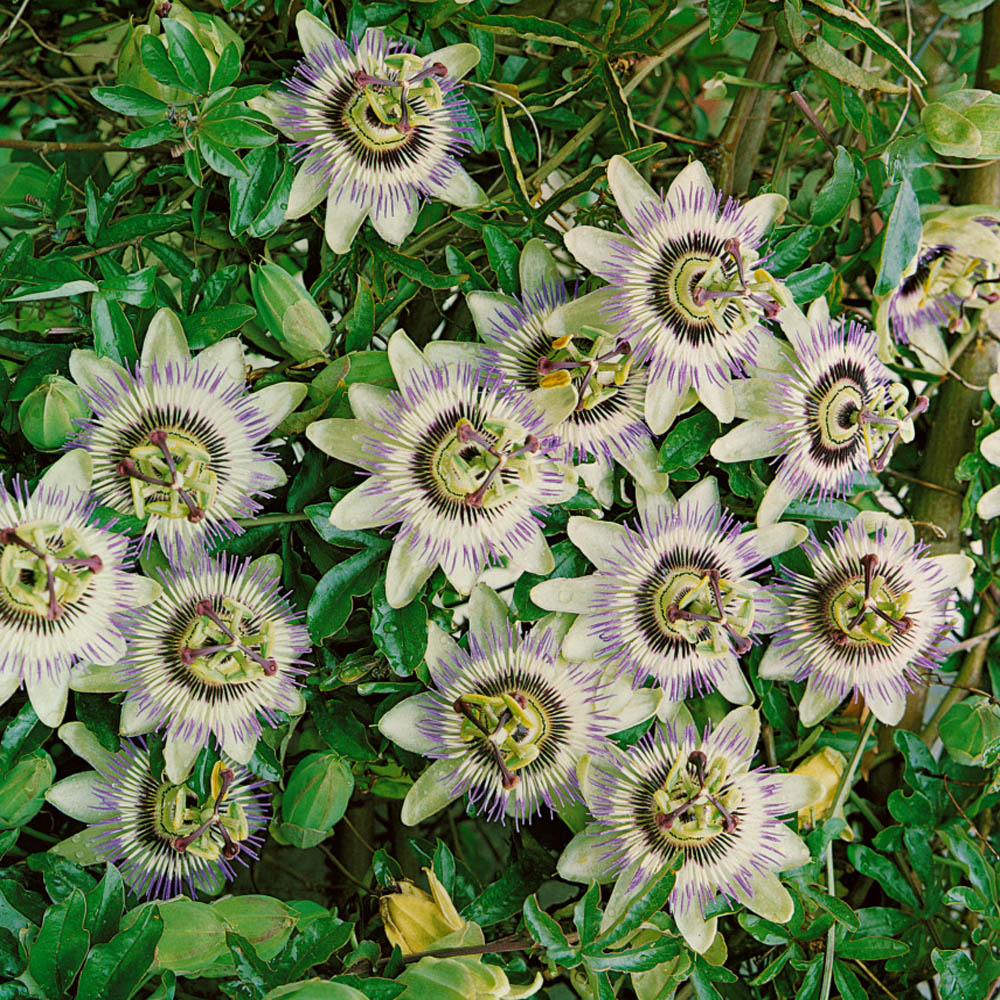
BM67 Blue Passionflower ( Passiflora caerulea )
Annual. Blue passionflower is a twining vine that can grow to 30 ft (9.1 m). The shiny leaves are usually palmately lobed with five parts, but they can have as few as three lobes or as many as nine. They are evergreen in tropical climates, but deciduous where winters are cool. The white and purple-blue flowers which appear in summer may be as large as 4 in (10.2 cm) across. They are followed by egg-size deep orange fruits from late summer through fall.
Blue passionflower likes loose sandy or gravelly soils and does best planted in old brick rubble that retains heat during cold winter weather. Too much manure or compost will result in lush vegetative growth and poor flowering. This species will flower in a small pot, but it prefers plenty of root space and will do better in a roomy container. In Zone 8-9, the ideal location is against a warm south-facing old brick wall where an overhang prevents excessive drenching by heavy rains.
Go light on fertilizer and water deeply, but infrequently; passionflowers should be encouraged to reach deep into the earth for water. When motivated to do so, they are capable of developing amazing root systems to sustain them through droughts and freezes. Passionflowers love high humidity, but they are subject to fungal diseases if they don't get good air circulation in the greenhouse. Blue passionflower does better overwintered in a cool greenhouse where it can go semi-dormant as opposed to in a hothouse where it will be tempted to put too much energy into weak off-season growth. In either case, it is important to keep the soil on the dry side in the winter.
Blue passionflower may be wound around a hoop support to keep it within bounds so that it may be grown as a houseplant in a sunny south-facing window. Passifloras flower on new growth, so they may be pruned early in the growing season. It is best to cut some stems back nearly to the base, rather than just trim the tips. The terminal buds may be pinched out to encourage branching. Always keep some green foliage on the plant to keep the sap rising and encourage rapid regrowth. The roots may be weakened and become subject to fungal infection if too much top growth is removed at once. Don't try to train a passionflower to be too neat and compact; branches allowed to hang loose and droop a bit will be the ones most inclined to flower. Passionflowers are subject to a wide array of pests and diseases, but most of them have minimal impact on well grown plants. Butterfly larvae are the exception; caterpillars readily devour the foliage of healthy mature plants.
Passionflowers like full sun and will scramble over trees and shrubs to get it.
Hardiness: USDA Zones 8-11. Blue passionflowers will regrow from deep roots after even severe freezes. They have been known to survive temperatures as low as 5 degrees when the ground was frozen over two feet deep! It is nevertheless important to keep the soil as warm as possible, especially in the winter greenhouse.
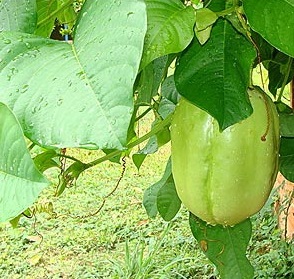
2640 Giant Granadilla ( Passiflora
quadrangularis )
The Giant Granadilla forms a larger leaf and is a more vigorous
grower than the yellow passion fruit. This plant derives its
botanical name from the fact that the stems are quad rangular
in cross section. It is a vigorous grower that can grow 50 feet
or more in a single season, for zones 10 and higher, or warm
greenhouses.
Fruit of the giant granadilla reach a length of up to 12 inches
and turn yellow when mature. The pulp around the seeds is used
to flavor ice cream and to make a cooling drink. In addition,
the flesh of this fruit is edible. The green fruit is boiled
and eaten as a vegetable. The fully ripe flesh is eaten alone
or in combination with such fruits as papaya and pineapple

IP189 Sweet Granadilla ( Passiflora ligularis )
Annual. A vigorous vine that is woody at the base and climbs onto structures or high into trees using tendrils with heart-shaped 4 to 8 inch long leaves that are of a medium green color and paler below with prominent veins. In the warmer months of the year appear the 4 inch wide sweetly fragrant flowers, often in pairs at the leaf base. These flowers have greenish white sepals and light pinkish-white petals with 2 ranks of filaments that are banded with bluish purple.
The outer shell is hard and slippery, and has soft padding on the interior to protect the seeds. The seeds, which are hard and black, are surrounded by a gelatinous sphere of transparent pulp. The pulp is the edible part of the fruit and has a soft sweet taste. It is very aromatic and contains vitamins A, C, and K, phosphorus, iron, and calcium.
Winter Hardiness: 25-30° F
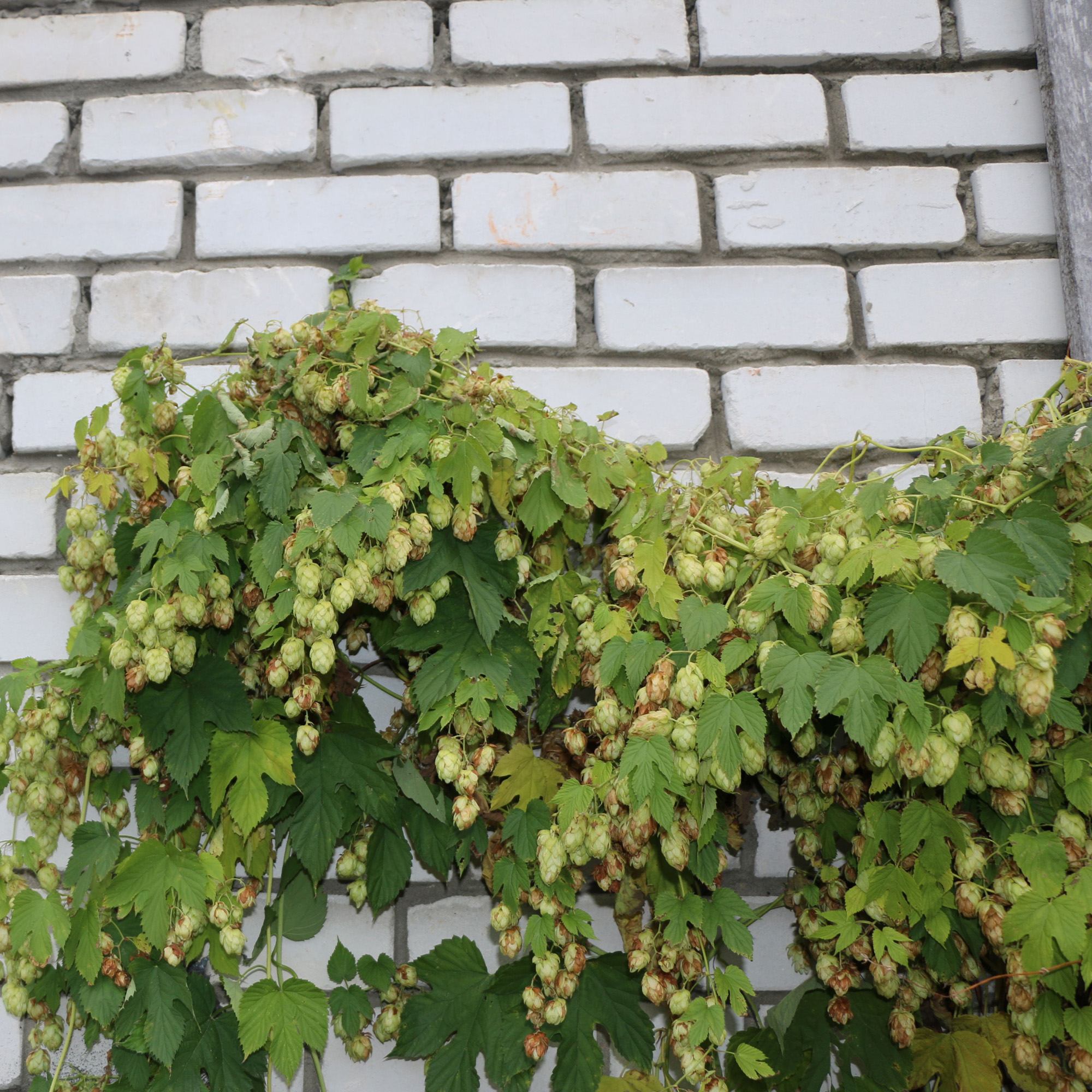
2903 Hops ( Humulus lupulus )
Humulus lupulus ( aka Hops ), is a perennial climber growing to almost 20 feet high at a medium rate. It is hardy to zone 5 and is not frost tender. It is in flower from Jul to August, and the seeds ripen from September to October. Hops are noted for attracting wildlife, pharmaceuticals, and beverage flavoring such as beer.
Hops produce rich, heavily scented, green-golden fruit that is harvested in autumn. The flowers of Humulus lupulus contain the chemicals myrcene, myrcenol, resin, linalool, humulene and tannins, all used extensively in the pharmaceutical industy. Also, another common usage is flavoring for the beer industry.
Hops seeds can be slow to germinate. Use a process called "cold scarification" to encourage hop seed germination. A good method is to put seeds in an equal amount of moist sand and refrigerate from one to three months at about 41 degrees F. After that, plant the seeds at 68 degrees F. for one to two months. If the hops seeds have not germinated, put them back in the refrigerator and repeat the cycle.
Decorative fast
growing vine, excellent for porches and screens.
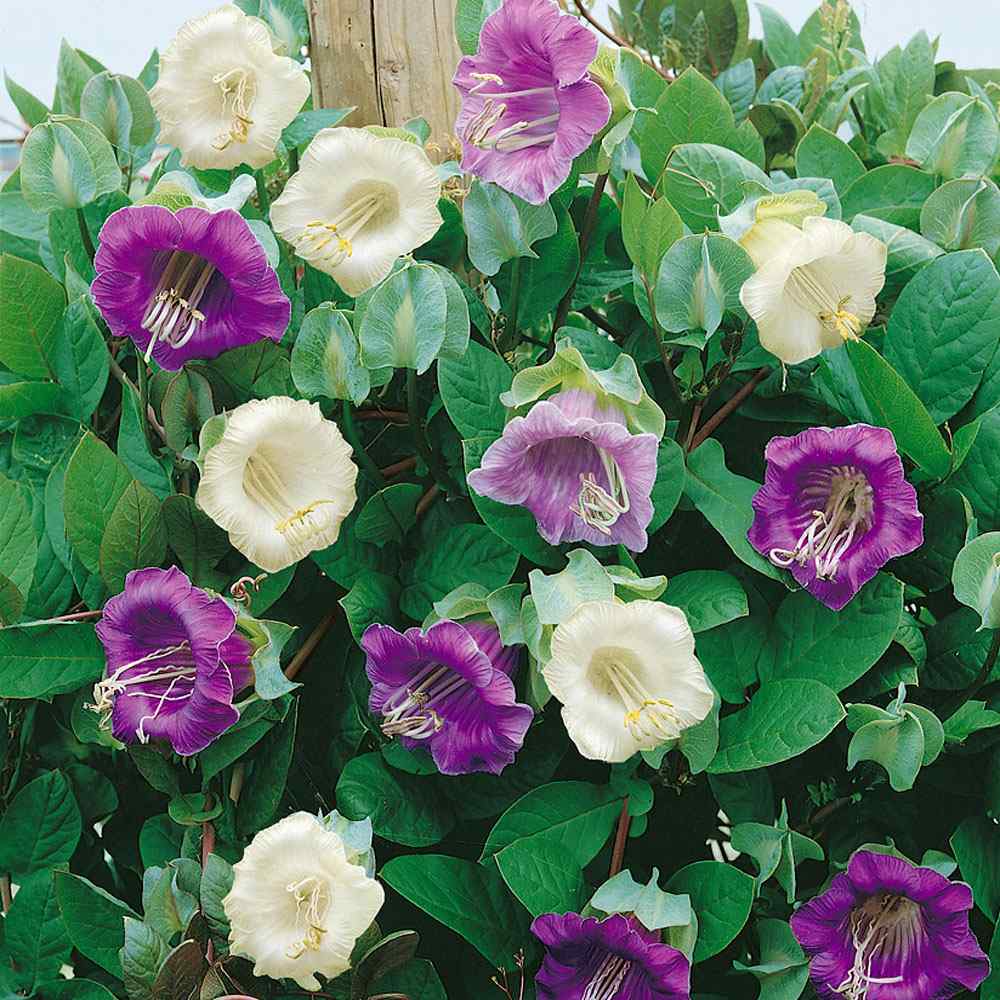
TWT279 Cup and Saucer Vine Mix ( Cobaea scandens )
Commonly called cup and saucer vine, this vining plant is native to Mexico and tropical South America. It is a vigorous, rapid-growing, climbing vine that typically grows to 30 - 40 feet in its native habitat! When grown as an annual, it can grow 10 - 20 feet in a single season even covering a 25 foot chain link fence in a single season. The descriptive common name is in reference to its bell-shaped flowers (cups), each of which is subtended by a saucer-like green calyx. Flowers last about 4 days, emerging green but maturing to purple or white. Flowers have a musky fragrance. Blooms late summer into fall. Also commonly called cathedral bells. Only perennial in USDA Zones 9 - 11.
Fantastical, 3 1/2 inch flaring violet and white bells sporting long sexy stamens create a massive bloom display that’ll be much admired by neighbors. Attractive, deep green, heart-shaped foliage. Give it room to grow, rich soil and stand back! Hummers will swarm! Cut back in Winter for bushiest appearance next year in warmer climates where it can survive as a perennial in zones 9-11.
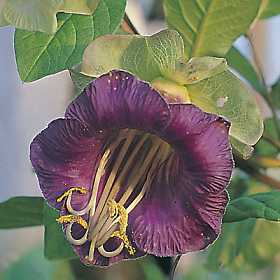
2237 Royal Plum Cup and Saucer Vine ( Cobaea scandens
)
5 Months of Blooms! Flowers mature from green to rich purple.
Statuesque vine sports outrageously large and glamorous-looking blooms along its length that can extend more than 20 feet. Extremely vigorous and puts on a great show when staked in large containers. Buds open creamy green, then change to rosy-violet and mature to a rich purple.
Height: 10-20'
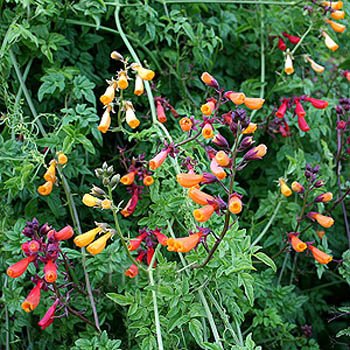
W184 Chilean Glory Vine ( Eccremocarpus tresco mix )
If you want hummingbirds in your garden, start Chilean Glory Vine plants! Chilean Glory Flower or Glory Vine is a fast-growing, evergreen climbing vine. The Glory Vine has tubular flowers that grow in clusters and are in colors of orange, yellow, pink, and shades of red. A long bloomer, Chilean Glory Flower has flowers from spring to autumn. The leaves are light green, small, oval-shaped and boldly veined. This climbing vine will quickly cover a trellis or arbor and makes a wonderful display in the landscape.
This is the perfect flowering plant for hummingbirds, and they visit it all day long. Chilean Glory Vine looks delicate, but it is vigorous and easy to grow and is considered a perennial in USDA Zones 9 - 10, but it will grow like an annual in colder zones. For areas with a long growing season, start the Eccremocarpus Scaber seeds directly outdoors in a prepared seedbed. In colder zones, start the flower seeds indoors 6 - 8 weeks before the end of frost season.
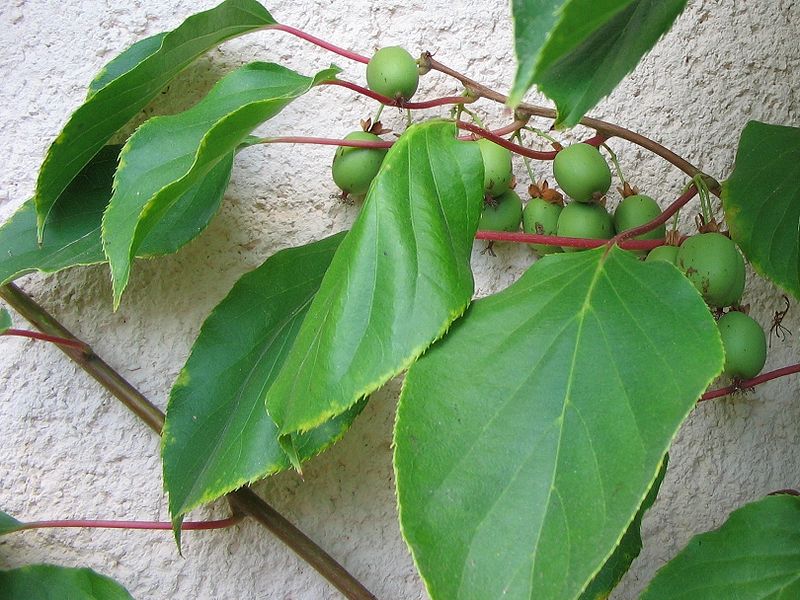
IP073 Artic Kiwi, Siberian Gooseberry ( Actinidia
arguta )
A strong-growing vine with dense, dark green foliage. The
fragrant but inconspicuous white flowers appear in early
spring. The fruit, which ripens in late summer or fall, is
about 3/4"-11/4" long. It tastes much like the commercial kiwi
fruit, to which it is closely related, but is somewhat sweeter
and has smooth skin. The seeds are very small and not
noticeable, so eating the fruits is somewhat like eating large
seedless grapes. Most selections should be hardy to around
-30° F. In the native Asian habitat of this species the
vines typically grow wild in trees, where they are known to
climb as high as 100'.
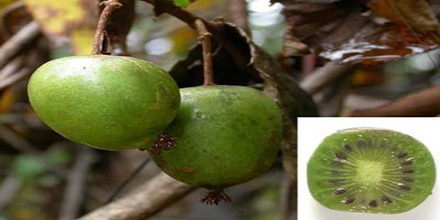
D8581 Issai Kiwi ( Actinidia )
Small 1" fruits with a very sweet taste. The vines will grow vigorously and bears loads of small fruit that is great for salads, desert or jelly. A vigorous, fast-growing, deciduous,
woody vine that grows 25-30' but can fill a 200 sq. ft. trellis in time. Grown for its foliage and edible fruit. Foliage is a lustrous dark green throughout the growing season. Flowers appear in May-June and are slightly fragrant and greenish white, but are not particularly showy since they are largely hidden by the foliage. This cultivar does not require a separate male pollinator plant. Smooth-skinned kiwi fruits ripen in early fall and are the size of a large grape. It tastes similar to, though slightly sweeter than, its
larger-fruited relative, the true kiwi, Actinidia deliciosa, which can not be grown north of Zone 8.
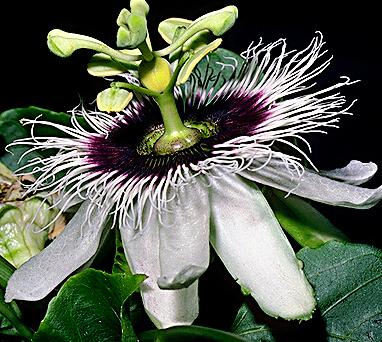
D8564 Passion Fruit ( Passiflora edulis )
Grown as annual. Zone 7 and higher. This vine, native to the Amazon, produces
beautiful flowers and sweet-tart fruit. It was named by the
Spanish missionaries in South America who saw the Passion
(suffering) of Christ represented in its flowers. Passion fruit
is widely grown throughout the tropics and subtropics. The
fruit is produced on a woody vine from bisexual flowers. The
fruit is somewhat tart, has a hard purple or yellow rind, and
contains many black seeds. Passion fruit is commonly used in
beverages. Grow on fences or trellises, or allow it to scramble
over shrubs and trees.

D8587 Banana Passion Fruit ( Passiflora
Mollissima )
For warmer zones, can be greenhouse grown, or in tubs on patio.
A beautiful vine with large 3-lobed leaves followed by edible
yellow fruits 4" in length. Cannot ship to HI.





.jpg)

