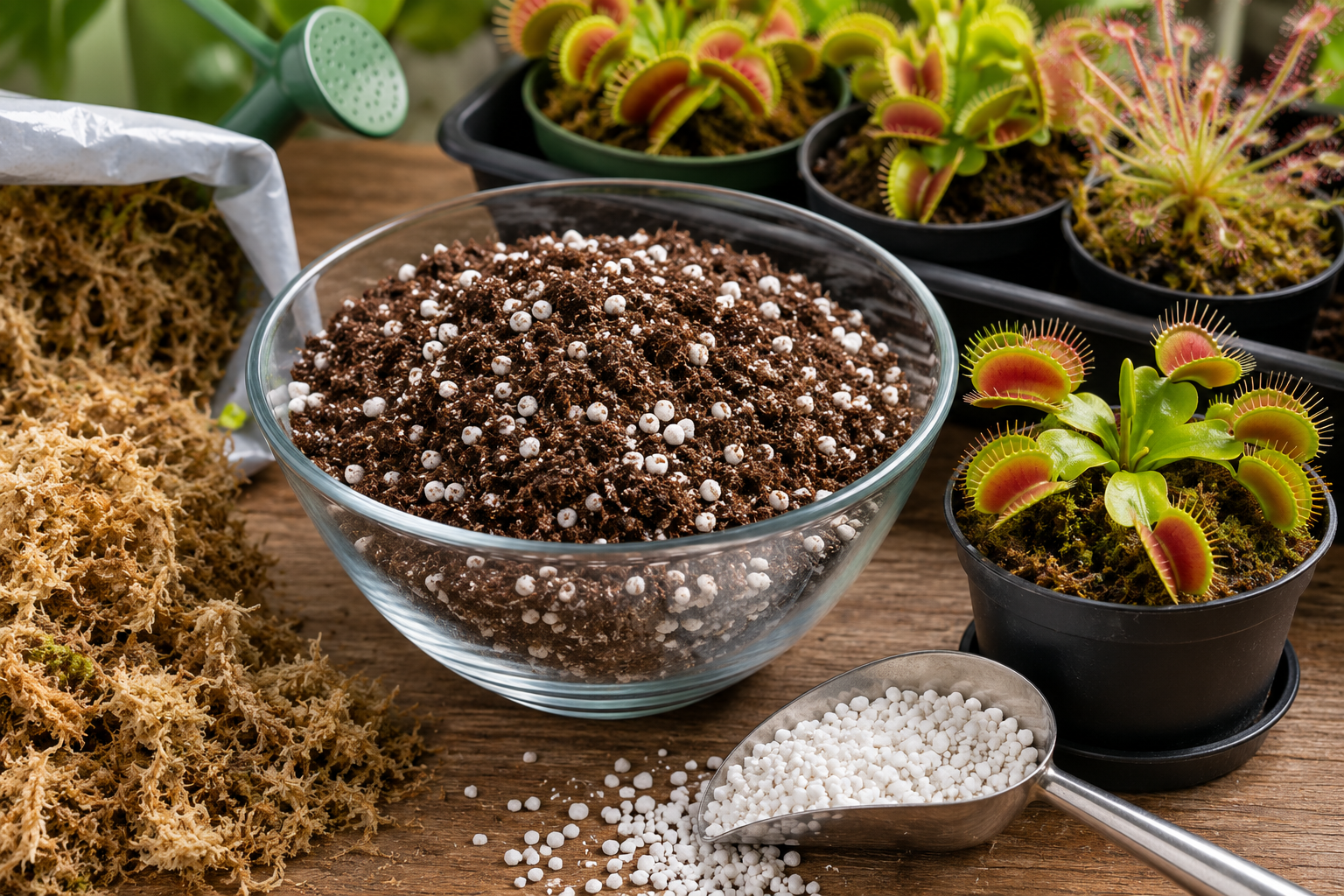
Homemade growing medium for Venus Flytraps and other carnivorous plants — A simple homemade carnivorous plant potting mix can provide excellent conditions for starting and growing Venus Flytraps, Sundews, Pitcher Plants, and many other insect-eating plants.
Unlike ordinary garden plants, carnivorous species naturally grow in nutrient-poor bogs and wetlands. These plants are adapted to acidic, low-fertility conditions and should never be grown in regular potting soil, compost, manure, or fertilizer-enriched planting mixes.
This Seedman guide explains how customers can create an inexpensive carnivorous plant growing medium using commonly available materials.
Order Venus Flytrap Seeds from Seedman
Purpose:
Seed starting and container growing for Venus Flytraps and other carnivorous plants
Recommended Plants:
Venus Flytrap, Sundews, Pitcher Plants, Cobra Lily, and many bog-loving carnivorous plants
Drainage:
Excellent
Moisture Retention:
High
Fertilizer Requirement:
None
Preferred Conditions:
Acidic, low-nutrient, consistently moist growing medium
Carnivorous plants evolved in nutrient-poor wetlands where ordinary plants often struggle. Because these environments contain very little available nutrition, plants such as the Venus Flytrap developed the ability to capture insects as a supplemental food source.
Regular potting soil, compost, manure, or fertilizer-enriched mixes can damage sensitive roots and may shorten plant life. A poor, acidic growing medium is one of the most important keys to success.
Moisten both ingredients before mixing. Blend thoroughly and fill containers loosely without packing the medium tightly. This mix retains moisture while allowing air to reach the roots.
This mixture more closely resembles the sandy bog soils where many carnivorous plants naturally grow. Use only clean coarse silica sand, not beach sand, play sand with additives, or limestone-based sand.
Do not use ordinary garden or houseplant soil for Venus Flytraps. Many common growing products contain fertilizers, minerals, or composted materials that are too rich for carnivorous plants.
Carnivorous plants are highly sensitive to dissolved minerals. The type of water used is just as important as the potting mix.
Recommended water sources:
Avoid:
Plastic pots or glazed containers are generally preferred because they do not release minerals into the growing medium. Unglazed clay pots can sometimes leach minerals and may dry too quickly.
Keep the soil consistently moist. Many growers place the pot in a shallow tray containing about 1/2 to 1 inch of pure water, allowing the growing medium to absorb moisture from below.
Never allow Venus Flytraps to completely dry out. At the same time, avoid stagnant, foul-smelling conditions by using clean containers and fresh growing medium.
Fill a clean container with moist carnivorous plant mix. Sow seeds on the surface and lightly press them into the medium. Venus Flytrap seeds are small and should not be deeply buried.
Provide bright light, consistent moisture, and pure water. A humidity dome or clear cover may help maintain moisture during germination, but provide some air exchange to reduce mold.
Seed germination can vary depending on seed freshness, temperature, light, and growing conditions. Seedlings are very small at first and should be kept evenly moist as they develop.
Long-fiber sphagnum moss can also be used by itself for starting and growing Venus Flytraps. It holds moisture well while allowing excellent air circulation around developing roots.
If using long-fiber sphagnum, soak it thoroughly in pure water before planting and avoid compacting it too firmly around the roots.
Suggested filename: carnivorous-plant-potting-mix.jpg
Alt text: Homemade carnivorous plant potting mix made from peat moss and perlite for Venus Flytrap growing
Image prompt: Realistic gardening image showing peat moss, perlite, and finished carnivorous plant potting mix beside healthy Venus Flytrap plants, gardening workbench, natural lighting, seed catalog style, highly detailed, no text.
Visit the original Seedman product page for current availability, package sizes, and ordering details.
View Seedman Venus Flytrap Seed Page
No. Regular potting soils usually contain nutrients, compost, or fertilizers that can damage carnivorous plants.
Sphagnum peat moss is one of the most commonly used ingredients because it provides acidity and moisture retention similar to natural bog habitats.
Yes. Coarse silica sand can be used as an alternative drainage material. Avoid beach sand, builders sand with additives, and limestone-based sand.
No. Venus Flytraps and many other carnivorous plants should not be fertilized in the usual way. They are adapted to low-nutrient soil and obtain supplemental nutrients from insects.
Rainwater, distilled water, or reverse-osmosis water are generally the safest choices. Avoid water with high mineral content.
Yes. This type of low-nutrient, acidic mix is often suitable for many bog-loving carnivorous plants, including Sundews and many Pitcher Plants. Individual species may have slightly different preferences.
Seedman.com — Serving gardeners since 1992
Carnivorous Plant Potting Mix Guide | Venus Flytrap Growing Medium