
Mountain Aloe Seeds
★★★★★ Giant Landscape Aloe Rating: 5 out of 5 Stars
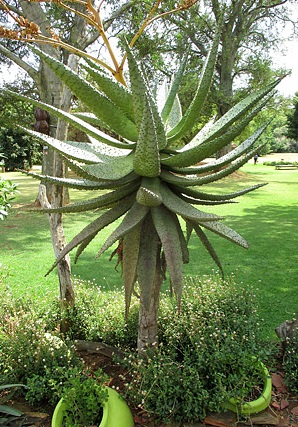
Mountain Aloe is one of the most impressive and majestic aloe species in cultivation. Native to the mountainous regions of southern Africa, this massive succulent develops into a dramatic trunk-forming specimen crowned by a dense rosette of broad gray-green leaves armed with reddish-brown spines.
As plants mature, they become truly spectacular landscape specimens, producing enormous candelabra-like flower displays that can be seen from great distances. During bloom, hundreds of brilliant orange to red-orange flowers cover the branching flower stalks, creating one of the most breathtaking floral displays in the succulent world.
Its combination of size, beauty, drought tolerance, and architectural form has made Mountain Aloe one of the premier landscape aloes for warm climates worldwide.
Plant Characteristics- Botanical Name: Aloe marlothii
- Common Names: Mountain Aloe, Flat-Flowered Aloe
- Plant Type: Evergreen succulent
- Mature Height: 8 to 15 feet
- Mature Width: 6 to 10 feet
- Growth Rate: Moderate
- USDA Zones: 9 to 11
- Foliage Color: Gray-green to blue-green
- Flower Color: Orange, red-orange, or yellow-orange
Mountain Aloe is ideal for xeriscape gardens, desert landscapes, succulent collections, Mediterranean gardens, public plantings, and large-scale architectural landscapes.
Its imposing size makes it a superb specimen plant and focal point.
Mature plants create dramatic silhouettes and year-round visual interest.
Germination InformationAloe seeds germinate readily under warm, moist conditions.
- Sow seeds on the surface of a well-drained cactus mix.
- Lightly cover with fine sand.
- Maintain temperatures between 70 and 85°F.
- Keep evenly moist but not saturated.
- Provide bright indirect light.
- Germination typically occurs within 2 to 6 weeks.
Mountain Aloe thrives in full sun and exceptionally well-drained soil.
Once established, plants are highly drought tolerant and require minimal supplemental irrigation.
Excellent drainage is essential, particularly during cooler weather.
The species develops best when given ample room to mature into its full architectural form.
Container GrowingYoung plants can be grown successfully in containers, but mature specimens eventually require large landscape settings.
Container-grown plants should be provided with deep pots and excellent drainage.
Many collectors grow young specimens for years before transplanting them into the landscape.
Pollinator ValueThe spectacular flower spikes attract hummingbirds, sunbirds, bees, butterflies, and numerous beneficial pollinators.
Flowering occurs during winter and early spring when nectar sources are often limited.
The blooms are among the most important nectar sources for wildlife in their native habitat.
Wildlife ValueMountain Aloe flowers provide abundant nectar for birds and pollinating insects.
The dense rosettes may also offer shelter for small wildlife and beneficial insects.
Large flowering specimens become important ecological resources in arid landscapes.
Historical and Cultural FactsMountain Aloe is native to South Africa, Botswana, Eswatini, and Mozambique.
The species was named in honor of German botanist Rudolf Marloth, one of southern Africa's most respected plant researchers.
For centuries, local communities have valued aloes for medicinal, ornamental, and practical uses.
Botanical Facts- Member of the Asphodelaceae family.
- One of the largest trunk-forming aloe species.
- Leaves are armed with reddish spines on both margins and surfaces.
- Mature plants develop impressive tree-like forms.
- Flower spikes may contain thousands of individual blossoms.
- Among the most spectacular flowering aloes in cultivation.
Mature plants produce massive branched flower stalks that rise well above the foliage.
The horizontal to slightly angled flower clusters are distinctive and help distinguish the species from many other aloes.
Flowering usually occurs during winter and early spring.
Large specimens in bloom become unforgettable landscape attractions.
Drought ToleranceOnce established, Mountain Aloe exhibits exceptional drought tolerance.
Its thick succulent leaves efficiently store water, allowing the plant to thrive in regions with extended dry seasons.
The species is highly valued in water-wise and xeriscape landscapes.
Seedman's NoteMountain Aloe is one of the grand giants of the aloe world. Its immense flower displays and stately trunk-forming habit make it one of the most impressive succulents a gardener can grow.
Additional Seedman's NoteIf you're looking for a dramatic specimen plant capable of becoming the centerpiece of a drought-tolerant landscape, Mountain Aloe is an outstanding choice. Few succulents can rival its combination of size, beauty, and spectacular winter flowering displays.
For over a thousand more unique seed varieties, all in stock and ready to ship, visit our Seed Catalog Index Page .

Contact Us | Privacy Policy | About Us
Serving gardeners since 1992
State of Mississippi Seedmen's Permit #C-391, Ohio 90152, Minnesota 20086777