
Mancan Buckwheat Seeds
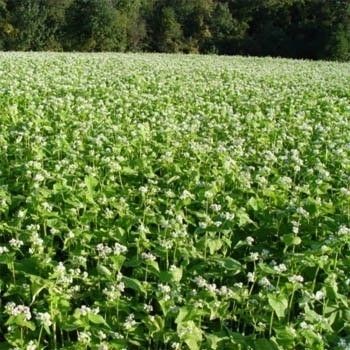
Buckwheat can be helpful in managing Verticillium wilt, a soilborne fungal disease, by enhancing soil health through its ability to scavenge phosphorus and add nitrogen. A study on potatoes showed that treating soil with nitrogen and phosphorus multiple times can significantly reduce Verticillium wilt, and buckwheat excels in this regard. Additionally, buckwheat can act as a green mulch when it's no longer needed.
Buckwheat is a plant of many uses. Though frequently used culinarily as a cereal grain, buckwheat is actually a seed—it’s also a great source of fiber, vitamin B6, and minerals such as magnesuim and zinc. It is naturally gluten-free and can be purchased roasted, as unroasted groats, as noodles, or in flour form. It has been eaten in Asian and Eastern European countries for centuries, but is now becoming increasingly popular in the west due to its many health benefits.
Buckwheat has a deep earthy and nutty flavor. In its unroasted form it is pale green and usually sprouted, and it is labeled as "groats." When you see buckwheat in its light tan form, it has been roasted. Roasted buckwheat, commonly known as "kasha," is tender and grain-like, and it works well in porridge. Despite having "wheat" in the name, buckwheat is in fact gluten-free.
Summer annual which can be used as a green manure crop. An early maturing wheat suitable for almost any type soil. Seeds remain on stalk after ripening, providing food over extended period of time. Buckwheat has a short growing season, maturing in 10 to 12 weeks. It is quickly killed by frost.
Benefits of Buckwheat Cover Crops: Quick cover. Few cover crops establish as rapidly and as easily as buckwheat. Its rounded pyramid- shaped seeds germinate in just three to five days. Leaves up to 3 inches wide can develop within two weeks to create a relatively dense, soil shading canopy. Buckwheat typically produces only 2 to 3 tons of dry matter per acre, but it does so quickly—in just six to eight weeks. Buckwheat residue also decomposes quickly, releasing nutrients to the next crop.
Weed suppressor. Buckwheat’s strong weed suppressing ability makes it ideal for smothering warm-season annual weeds. It’s also planted after intensive, weed-weakening tillage to crowd out perennials. A mix of tillage and successive dense seedings of buckwheat can effectively suppress Canada thistle, sowthistle, creeping jenny, leafy spurge, Russian knapweed and perennial peppergrass. While living buckwheat may have an allelopathic weed-suppressing effect, its primary impact on weeds is through shading and competition.
Phosphorus scavenger. Buckwheat takes up phosphorus and some minor nutrients (possibly including calcium) that are otherwise unavailable to crops, then releasing these nutrients to later crops as the residue breaks down. The roots of the plants produce mild acids that release nutrients from the soil. These acids also activate slow-releasing organic fertilizers, such as rock phosphate. Buckwheat’s dense, fibrous roots cluster in the top 10 inches of soil, providing an extensive root surface area for nutrient uptake.
Thrives in poor soils. Buckwheat performs better than cereal grains on low-fertility soils and soils with high levels of decaying organic matter. That’s why it was often the first crop planted on cleared land during the settlement of woodland areas and is still a good first crop for rejuvenating over-farmed soils. However, buckwheat does not do well in compacted, droughty or excessively wet soils.
Quick regrowth. Buckwheat will regrow after mowing if cut before it reaches 25 percent bloom. It also can be lightly tilled after the midpoint of its long flowering period to reseed a second crop. Some growers bring new land into production by raising three successive buckwheat crops this way.
Soil conditioner. Buckwheat’s abundant, fine roots leave topsoil loose and friable after only minimal tillage, making it a great mid-summer soil conditioner preceding fall crops in temperate areas.
Nectar source. Buckwheat’s shallow white blossoms attract beneficial insects that attack or parasitize aphids, mites and other pests. These beneficials include hover flies (Syrphidae), predatory wasps, minute pirate bugs, insidious flower bugs, tachinid flies and lady beetles. Flowering may start within three weeks of planting and continue for up to 10 weeks.
For over a thousand more unique seed varieties, all in stock and ready to ship, visit our Seed Catalog Index Page .

Contact Us | Privacy Policy | About Us
Serving gardeners since 1992
State of Mississippi Seedmen's Permit #C-391, Ohio 90152, Minnesota 20086777