
Oriental Thuja Seeds
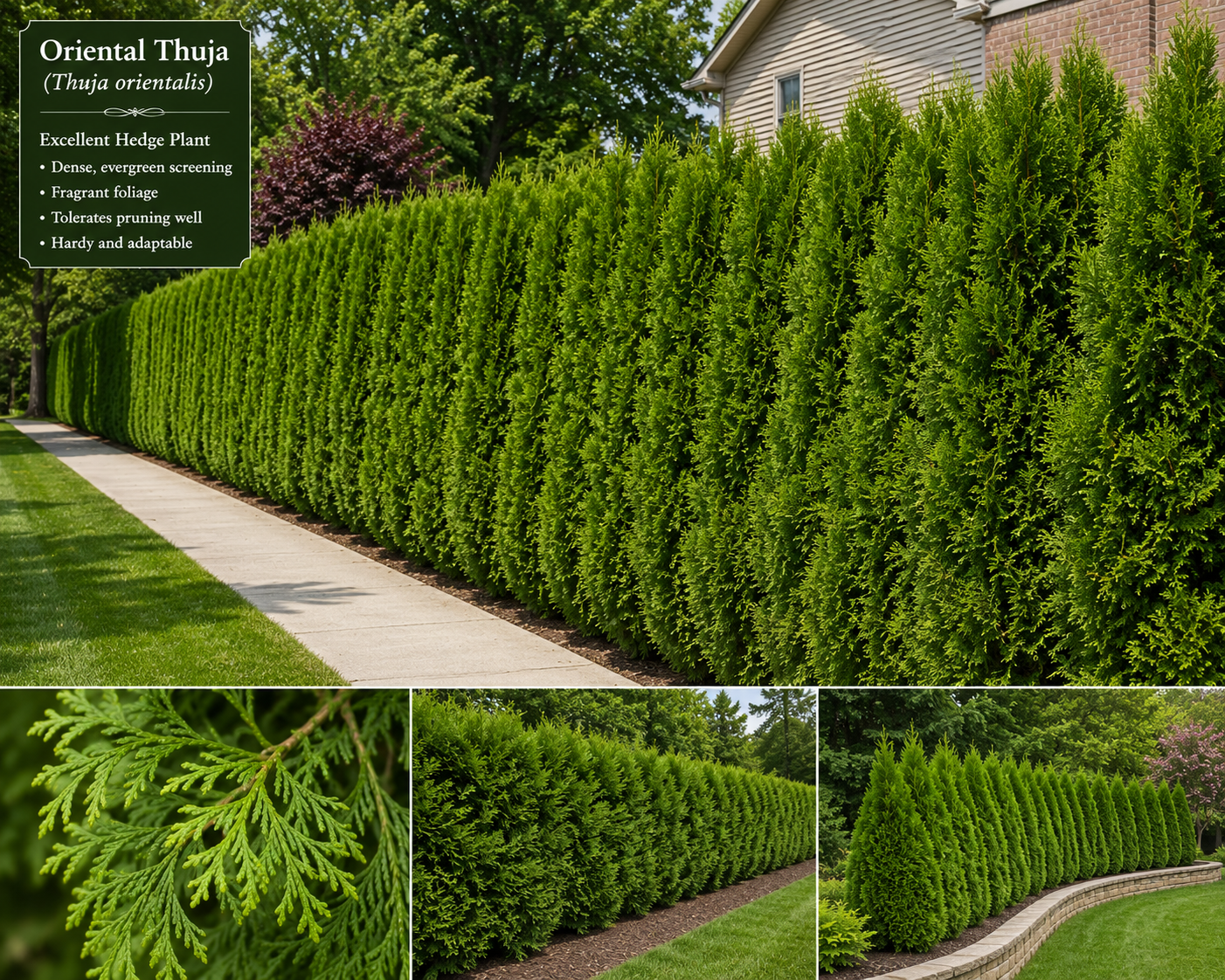
Oriental Thuja is one of the world's most popular evergreen hedge and screening plants. Native to northern China, Korea, and parts of eastern Asia, it has been cultivated for centuries as a living fence, privacy screen, windbreak, and ornamental landscape plant.
Its dense evergreen foliage forms a natural wall of greenery that remains attractive throughout the year. Unlike many hedge plants that require constant maintenance, Oriental Thuja combines beauty, durability, and adaptability into a remarkably easy-to-grow package.
Whether used as a formal clipped hedge or allowed to develop naturally, this handsome evergreen provides year-round structure, privacy, and landscape value.
Plant Characteristics- Botanical Name: Platycladus orientalis (formerly Thuja orientalis)
- Common Names: Oriental Thuja, Oriental Arborvitae, Chinese Arborvitae
- Plant Type: Evergreen conifer
- USDA Zones: 5-9
- Height: 15-40 feet
- Spread: 8-15 feet
- Sun Requirements: Full sun to partial shade
- Growth Rate: Moderate
- Foliage Color: Bright green to rich emerald green
- Winter Interest: Excellent evergreen foliage
Oriental Thuja is prized for its versatility and is widely used throughout residential and commercial landscapes.
- Privacy hedges
- Living fences
- Windbreaks
- Property screens
- Foundation plantings
- Formal garden hedges
- Noise barriers
- Specimen evergreen plantings
When planted in rows, the trees gradually form an attractive green wall that provides year-round privacy and shelter.
Important Hedge NoteOriental Thuja responds exceptionally well to pruning and shaping. This characteristic has made it one of the most popular hedge plants in gardens worldwide. Regular trimming encourages dense branching and creates an attractive, uniform hedge.
Germination Instructions- Cold stratify seeds for 30-60 days at 34-40°F.
- Sow seeds on the surface of a well-drained growing medium.
- Lightly cover with fine soil or vermiculite.
- Maintain temperatures of 65-75°F.
- Keep the medium consistently moist.
- Provide bright light.
- Germination typically occurs within 2-6 weeks.
- Transplant seedlings carefully when established.
Oriental Thuja performs best in full sun but tolerates partial shade. It adapts well to a wide range of soil conditions and is considerably more tolerant of drought and difficult soils than many evergreen hedge plants.
Once established, it requires relatively little maintenance beyond occasional pruning.
The species tolerates urban conditions, heat, wind, and moderate drought, making it a dependable landscape choice.
Container GrowingYoung plants grow well in containers and can be maintained for several years before landscape planting.
- Use containers with excellent drainage.
- Provide regular watering.
- Place in full sun whenever possible.
- Feed lightly during the growing season.
- Prune to maintain shape if desired.
Container-grown specimens are often used as patio evergreens or entryway accents.
Pollinator ValueAlthough not known primarily as a pollinator plant, Oriental Thuja produces pollen-bearing cones that contribute to local ecosystems. Dense hedges also provide shelter and protection for numerous beneficial insects.
The hedge itself often becomes a valuable refuge for pollinator populations.
Wildlife ValueDense evergreen growth provides nesting sites, winter shelter, and escape cover for songbirds and other wildlife. Many birds utilize mature hedges for nesting and protection from predators.
In winter, few landscape plants provide better shelter than a mature evergreen hedge.
Historical and Cultural SignificanceOriental Thuja has been cultivated in China for well over a thousand years and is frequently found in temple gardens, palace grounds, and historic landscapes. Ancient plantings were often associated with longevity, endurance, and spiritual symbolism.
The species eventually spread throughout Europe and North America, where it became a favorite hedge and ornamental evergreen.
Today it remains one of the most widely planted screening evergreens in the world.
Interesting Botanical Facts- Despite its common name, it is now classified as Platycladus orientalis rather than a true Thuja.
- The species can live for several hundred years.
- Ancient specimens still grow near historic temples in China.
- The foliage often develops attractive bronze tones during winter.
- It is one of the oldest cultivated ornamental conifers.
If there were a Hall of Fame for hedge plants, Oriental Thuja would deserve a prominent place. Few evergreens combine year-round beauty, adaptability, ease of pruning, and long-term reliability so successfully. Whether used as a privacy screen, windbreak, property divider, or formal landscape hedge, it consistently performs where many other plants struggle.
The rich green foliage creates an elegant backdrop for flowers, shrubs, and garden beds throughout the year.
Additional Seedman NoteOne of the most fascinating aspects of Oriental Thuja is its connection to ancient Chinese gardens. Some specimens planted near temples and sacred sites have survived for centuries, becoming living witnesses to generations of history. Long before modern landscaping existed, gardeners recognized the value of this durable evergreen as both a practical hedge and a symbol of permanence and endurance.
Hedge Plant Rating- Privacy Screen: ★★★★★
- Evergreen Value: ★★★★★
- Ease of Maintenance: ★★★★★
- Windbreak Potential: ★★★★☆
- Wildlife Shelter: ★★★★★
- Ornamental Appeal: ★★★★★
Overall Hedge Rating: One of the finest evergreen hedge plants available.
For over a thousand more unique seed varieties, all in stock and ready to ship, visit our Seed Catalog Index Page .

Contact Us | Privacy Policy | About Us
Serving gardeners since 1992
State of Mississippi Seedmen's Permit #C-391, Ohio 90152, Minnesota 20086777