
New Seed Arrivals | New Account |
Gift Certificates |
Gardening Products
SEEDS: Unusual | Annuals | Perennials | Vegetables | Herbs | Trees
Osage Orange Seeds
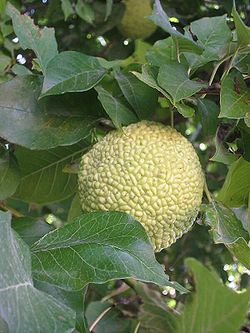
Image: By User:katpatuka [FAL], from Wikimedia Commons

D1717 Osage Orange ( Maclura )
A fast growing shrub often grown as a hedge. Pretty foliage with greenish flowers. Good
as a background or border plant.
Recent research suggests that elemol, another component extractable from the fruit, shows promise as a mosquito repellent with similar activity to DEET in contact and residual repellency. Notes:The Osage-orange is commonly used as a tree row windbreak in prairie states, which gives it one of its colloquial names, "hedge apple". It was one of the primary trees used in President Franklin Delano Roosevelt's "Great Plains Shelterbelt" WPA project, which was launched in 1934 as an ambitious plan to modify weather and prevent soil erosion in the Great Plains states, and by 1942 resulted in the planting of 30,233 shelterbelts containing 220 million trees that stretched for 18,600 miles (29,900 km). The sharp-thorned trees were also planted as cattle-deterring hedges before the introduction of barbed wire and afterward became an important source of fence posts. The heavy, close-grained yellow-orange wood is very dense and is prized for tool handles, treenails, fence posts, electrical insulators, and other applications requiring a strong dimensionally stable wood that withstands rot. Straight-grained osage timber (most is knotty and twisted) makes very good bows. In Arkansas, in the early 19th century, a good Osage bow was worth a horse and a blanket. Additionally, a yellow-orange dye can be extracted from the wood, which can be used as a substitute for fustic and aniline dyes. When dried, the wood has the highest BTU content of any wood, and burns long and hot. Today, the fruit is sometimes used to deter spiders, cockroaches, boxelder bugs, crickets, fleas, and other arthropods.
Leaves turn bright yellow in fall, thorny branches, bears inedible round fruit 3-5" in diameter. The fruit is prized for it's ability to repel insects and spiders when scattered around home foundations. The crushed fruits of this plant are said to attract and kill cockroaches. Can be raised as container plant in northern states.
The wood is sought after for recurve bow making. Both male and female plants are needed to produce fruit. The ratio of male/female plants the seeds produce is up to mother nature, but a pack of 10 seeds always produces a mix of male/female plants in all of our previous field trials. Can be grown in zones 4-9.
Recent research suggests that elemol, another component extractable from the fruit, shows promise as a mosquito repellent with similar activity to DEET in contact and residual repellency. Notes:The Osage-orange is commonly used as a tree row windbreak in prairie states, which gives it one of its colloquial names, "hedge apple". It was one of the primary trees used in President Franklin Delano Roosevelt's "Great Plains Shelterbelt" WPA project, which was launched in 1934 as an ambitious plan to modify weather and prevent soil erosion in the Great Plains states, and by 1942 resulted in the planting of 30,233 shelterbelts containing 220 million trees that stretched for 18,600 miles (29,900 km). The sharp-thorned trees were also planted as cattle-deterring hedges before the introduction of barbed wire and afterward became an important source of fence posts. The heavy, close-grained yellow-orange wood is very dense and is prized for tool handles, treenails, fence posts, electrical insulators, and other applications requiring a strong dimensionally stable wood that withstands rot. Straight-grained osage timber (most is knotty and twisted) makes very good bows. In Arkansas, in the early 19th century, a good Osage bow was worth a horse and a blanket. Additionally, a yellow-orange dye can be extracted from the wood, which can be used as a substitute for fustic and aniline dyes. When dried, the wood has the highest BTU content of any wood, and burns long and hot. Today, the fruit is sometimes used to deter spiders, cockroaches, boxelder bugs, crickets, fleas, and other arthropods.
Leaves turn bright yellow in fall, thorny branches, bears inedible round fruit 3-5" in diameter. The fruit is prized for it's ability to repel insects and spiders when scattered around home foundations. The crushed fruits of this plant are said to attract and kill cockroaches. Can be raised as container plant in northern states.
The wood is sought after for recurve bow making. Both male and female plants are needed to produce fruit. The ratio of male/female plants the seeds produce is up to mother nature, but a pack of 10 seeds always produces a mix of male/female plants in all of our previous field trials. Can be grown in zones 4-9.
For over a thousand more unique seed varieties, all in stock and ready to ship, visit our Seed Catalog Index Page .

Contact Us | Privacy Policy | About Us
Serving gardeners since 1992
State of Mississippi Seedmen's Permit #C-391, Ohio 90152, Minnesota 20086777