
Yucca Plant seeds
Cactus Plant seeds
Most succulent seeds require light for germination. For maximum germination, we highly recommend using our VG07 Seedcover for tiny and pelleted seeds.
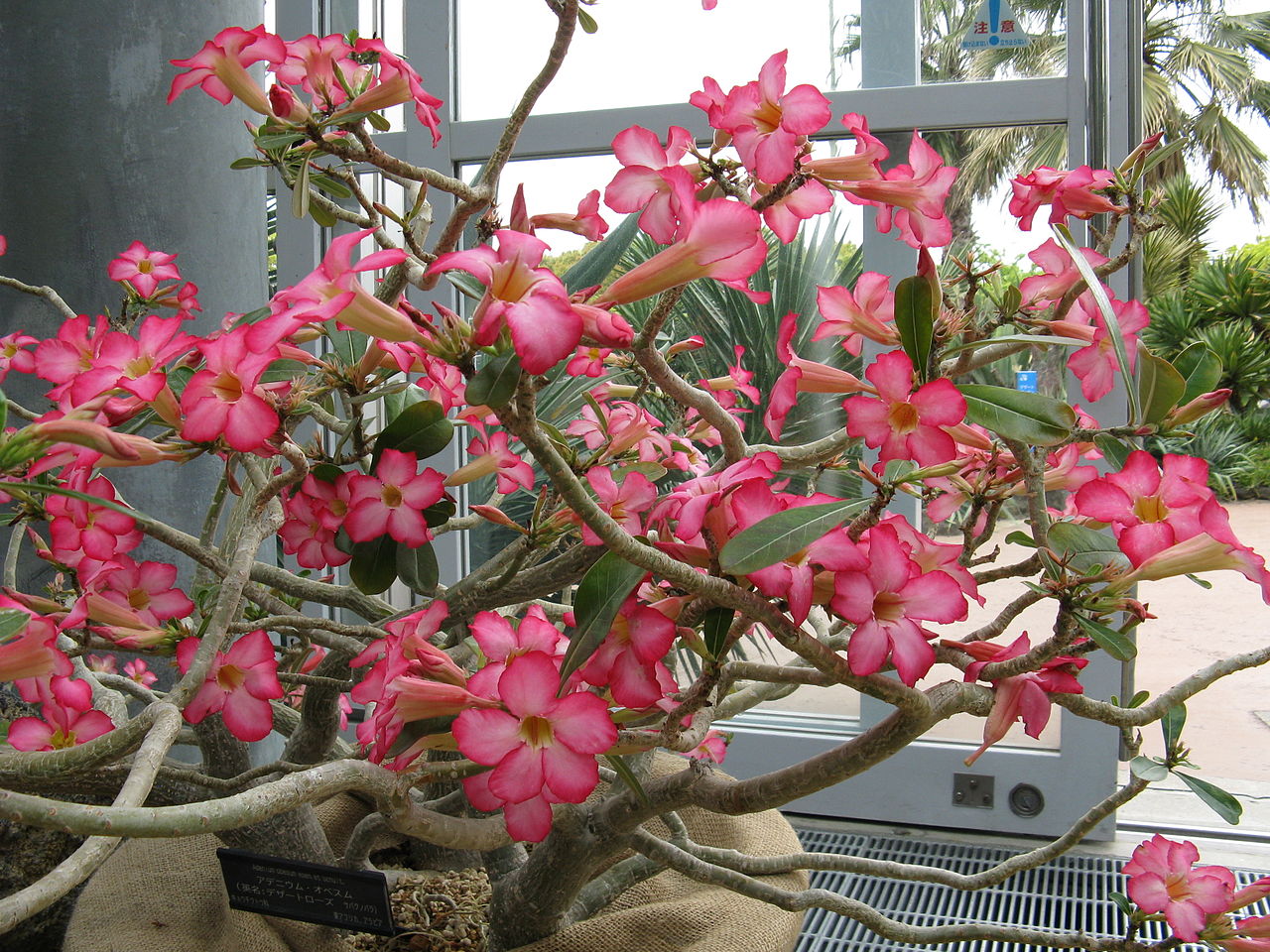
This carefree succulent boasts an unusual trunk (caudex) shape coupled with bunches of beautiful, colorful, trumpet-shaped flowers in an abundance of carmine-rose colors.
The plant makes an excellent warm-weather addition to your patio, deck or landscape, and it also does very well as a bonsai or houseplant.
Winter hardy to Zone 11. In colder zones, plants should be grown in containers and overwintered indoors. In containers, desert rose is best grown in a loose, sandy or gravelly, well-drained soil mix in full sun. Plants have excellent heat tolerance. Apply regular moisture during periods of growth, but allow soils to dry between waterings. Regular applications of fertilizer in spring will help promote flowering. Plants can be left outdoors in sunny locations during the summer. As soon as temperatures begin to dip below 55 degrees F. in autumn, bring containers indoors to sunny but cool locations with reduced watering. Plants usually lose their leaves in winter and go into a dormancy-like period. For container plants, the best caudex usually develops from seed-grown plants.
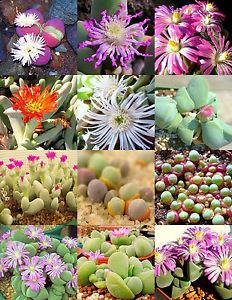
The leaves of Gibbaeum often look velvety, as many species have tiny hairs covering the leaves. The flowers are solitary and are always pink, white or mauve but never yellow, which is the colour of many other vygies from the Little Karoo. They flower from around July to November in response to rain. The flowers open in the afternoon and close in the evening. The fruit are dry capsules that have 6 to 9 segments. Many small, rounded seeds are found in each segment.
It is not known how long different individuals survive but these plants may survive for more then 20 years in the wild. Best grown in containers inside.
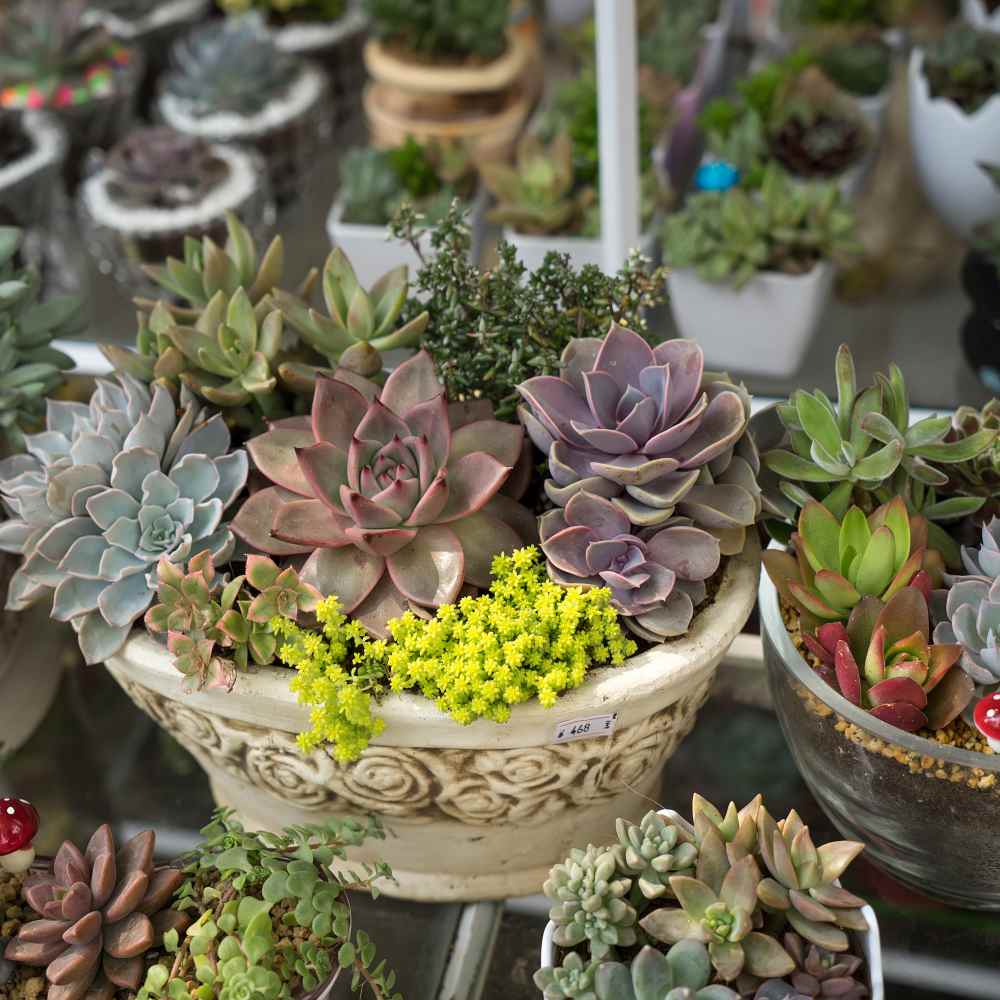
Grow Sempervivum succulent plants in full sun to partial shade and in well-drained soil. In the South, Sempervivum Hens and Chicks can profit from partial shade. The rosettes die after flowering but are replaced by new rosettes on lateral runners. Sempervivum is an old-time favorite used in concrete planters on either side of the front entry or as a great ground cover plant. Great in window boxes or niches. They require little water or attention to thrive.
These outdoor succulents are known for their charming appearance and extreme durability. They resemble an unfurled rose with accenets of colors and can form dense mats that accent gardens and arrangements. Perennial for zones 3-10.
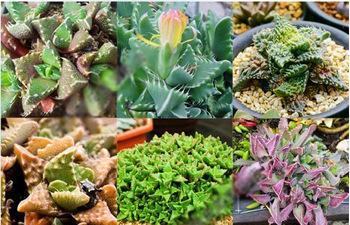
Faucarias form clumps of stemless rosettes. They are small plants, up to 3 inches in diameter, thick triangular or semi-circular leaves, light green in color, turning purple in the event of strong sunshine.
The various species make excellent pot subjects and have been cultivated in Europe for over three hundred years. Faucaria species are native to the Cape Province of South Africa and the Karoo Desert.
They bloom for several months in in fall or the beginning of winter. The flowers open around midday and close in the late afternoon. They often don’t open if the weather is cloudy, or if they are in the shade. Flower color ranges from yellow to white and even pink.
Most species will take a small amount of frost.
Mix consists of Faucaria albida, bosscheana, felina, subintegra, tigrina, tuberculosa and others, varieties vary from batch to batch.
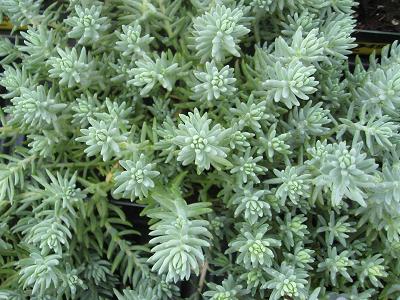
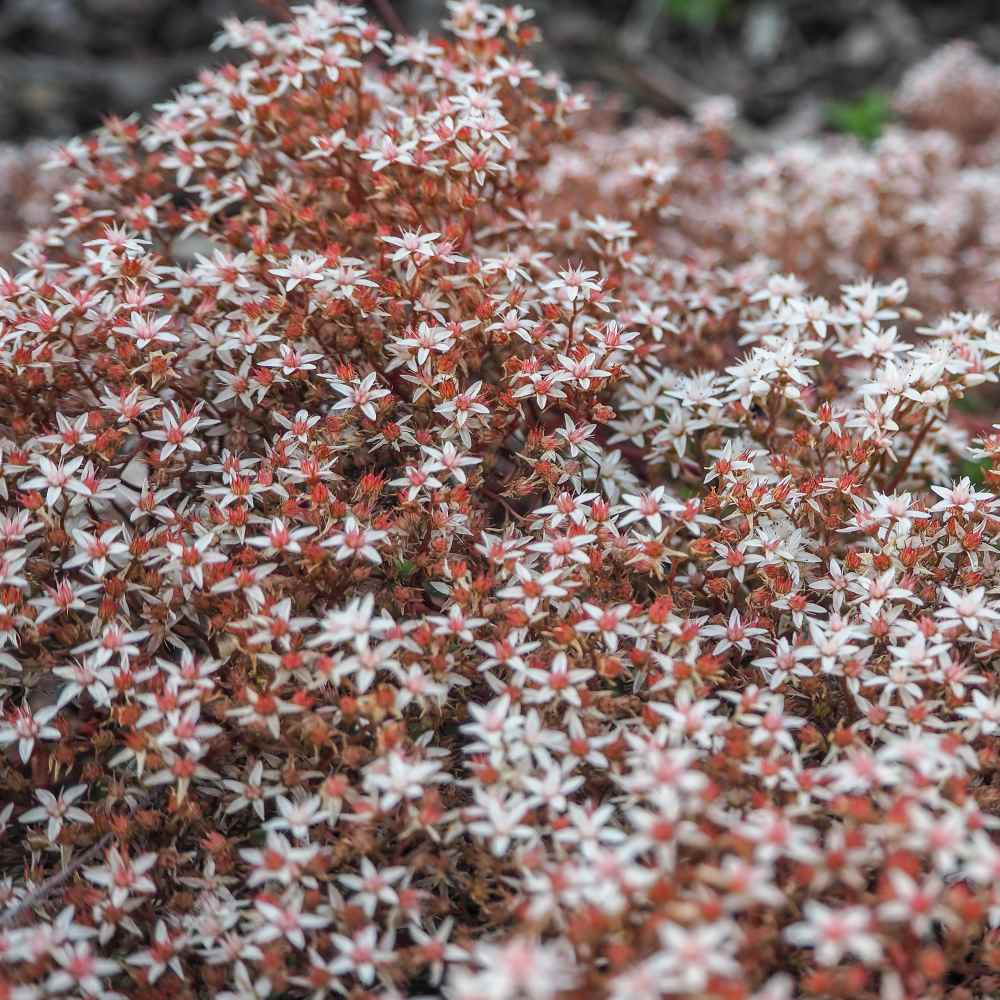
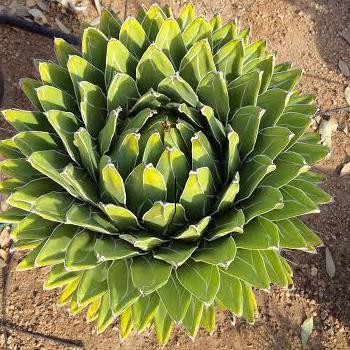
The leaves have contrasting, smooth, white margins and a short, black, terminal spine. In summer a single, 10-15' tall, unbranched flowering spike will emerge from the center of rosettes that are 15-30 years old. The flowering stalk is topped with an unbranched spike of yellow-green flowers. The rosette will dieback after blooming.
The specific epithet victoriae-reginae honors Queen Victoria (1819-1901), Queen of the United Kingdom from 1837 until her death.
For zones 8-10
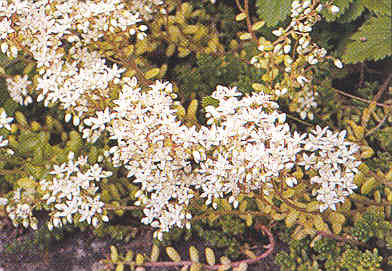
These leaves grow close together and form a dense carpet of plant material which spreads to cover a good-sized area. Dainty, airy white flowers bloom in midsummer. Foliage persists throughout the winter months, but turns red to bronze as temperatures become cooler.
A perennial for zones 3-9.
Sedum seeds should be started indoors and transplanted outdoors after germination. Indoor sowing can be done 6-8 weeks before last frost date. Use small pots or flats and sterile starter mix.
Pre-moisten the starter mix and sow 5-7 Stonecrop seeds per container. The seeds are exceptionally small, so only press the ground cover seed into the moistened soil, and do not cover the seed. Keep the seeds moist but not saturated until they germinate.
For outdoor sowing, wait until garden soil temperatures are 70°F. Select a site with well-draining soil. If necessary amend soil with organic matter. Loosen the top 1-2 inches of soil, remove any weeds, and gently broadcast the seeds over the soil.
Lightly press the seeds into the soil, and keep the seed continuously moist until germination. Normal germination time is 14-28 days. As a rule of thumb, 2,000 sedum seeds will cover a 40 square foot area as a ground cover.
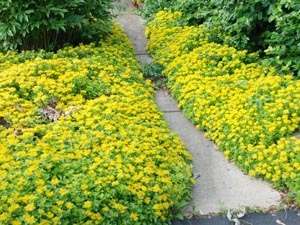
These plants will add distinction and beauty to any flower garden, rock garden, container, or planter box. They form a luxurious mound of dark green leaves that stay attractive 3 seasons of the year. As soon as summer arrives, hundreds of sunny yellow flowers will cover the attractive foliage. When Autumn approaches, the foliage takes on a soft pinkish hue.
For zones 4-9, grows about 4-6 inches tall.
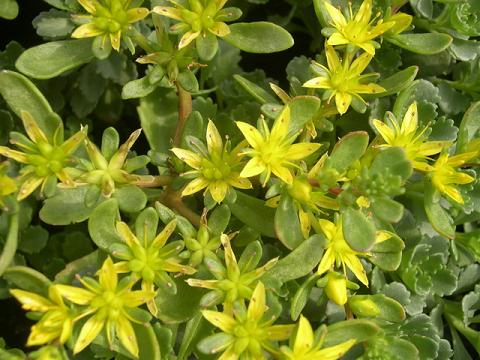
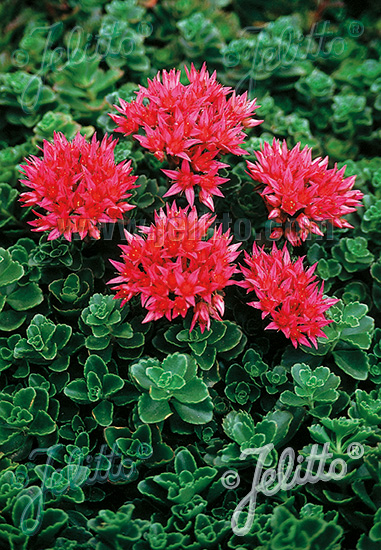
A low growing succulent plant that thrives in well-drained soil but will grow in most soil types. It's perfect to grow in trouble areas. Deer resistant.
For zones 5-10.
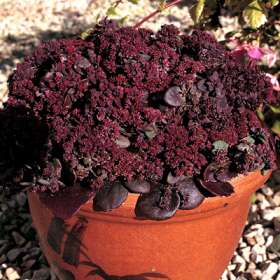
Each multi-seed pellet contains several seeds.
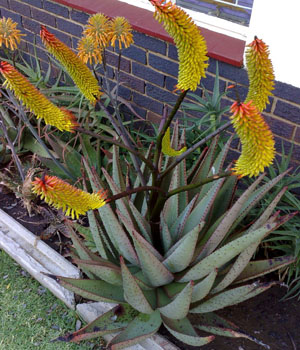
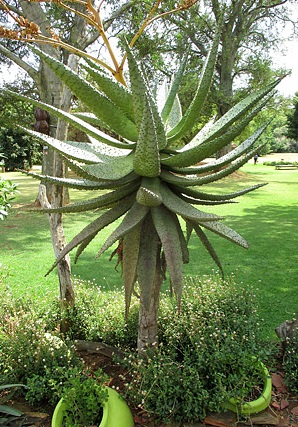
It grows a robust, solitary trunk that can reach an amazing 18 feet. The large, succulent, grayish to bluish green leaves can reach 4-5 feet long and are studded with short spines above and below. The old leaves form a dense skirt around the trunk below the crown. The large inflorescence holds a large number of flowers that can vary from yellow to orange to red.
In cultivation it is an easy to grow species for the dryish, warm temperate to tropical garden that can take drought and some cold with light freezes.
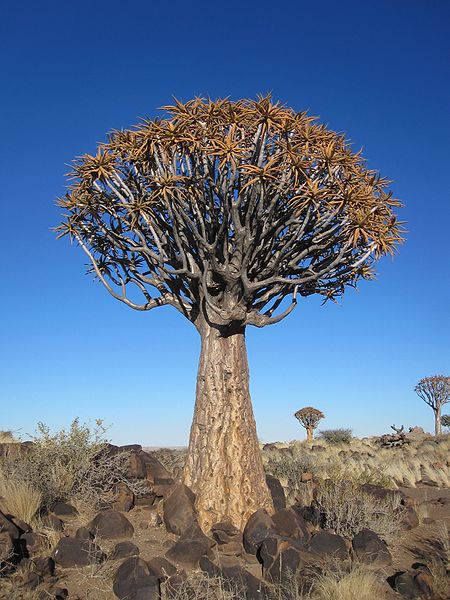

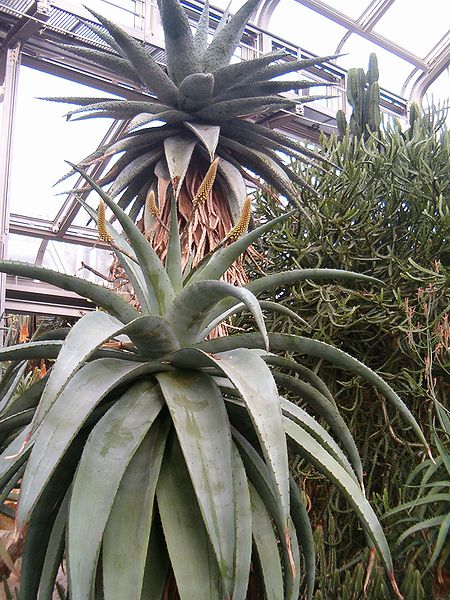

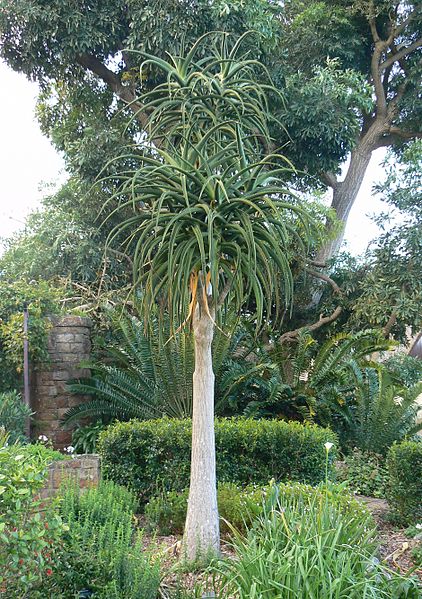

It is moderately drought tolerant and you should be careful not to overwater or plant in an area that has standing water.
Hardy to about 25 degrees F and reportedly survives short durations down to 22 degrees F. It is a great tree for the succulent garden and is fairly clean so good near a pool and can be kept many years in a large container. It does get a thick buttressed base with age so make sure to given it enough space to grow.
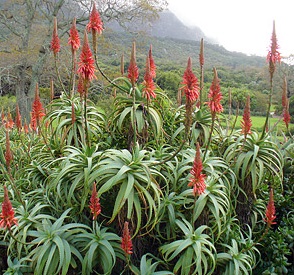
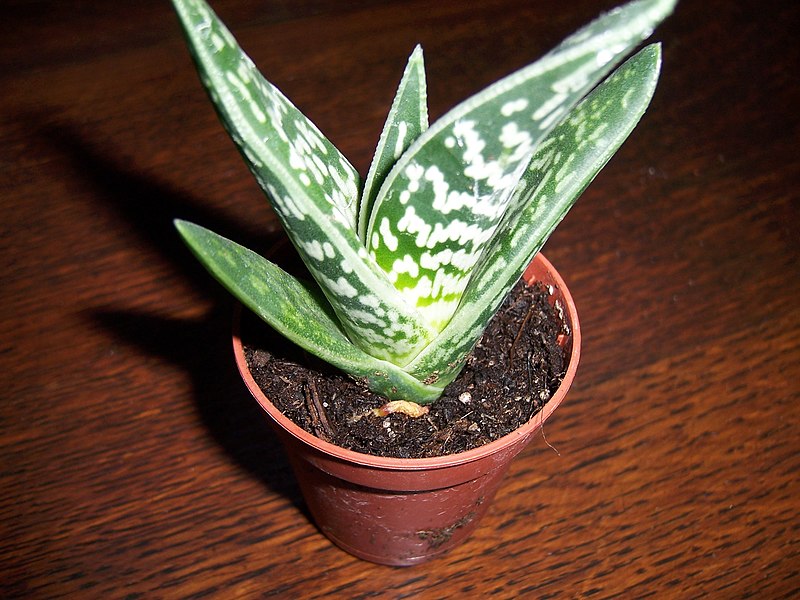
This large tree aloe grows naturally in the eastern part of southern Africa in Eastern Cape, KwaZulu-Natal, eastern Swaziland, Mpumalanga (Barberton District) and southern Mozambique where it is found in evergreen and margins of dry deciduous forests.
.jpg)
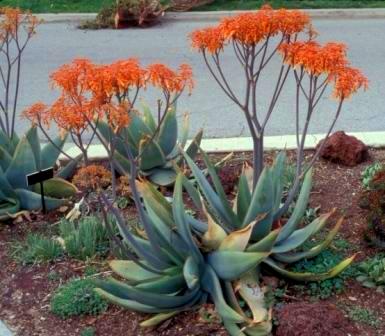
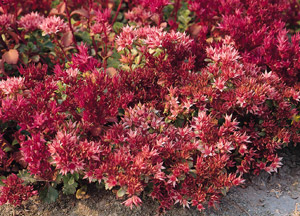
Dragon's Blood Sedum is a fast growing ground cover with brilliant red flowers in late summer. It is a succulent with needle-like leaves that turn an orange-red color in fall. Dragon's Blood ground cover creates a dense mat 3 - 5 inches tall that spreads quickly. Dragon's Blood will tolerate poor, dry soil. Low growing Sedum is used for containers, borders, edging and as a dense spreading ground cover plant. A perennial, these plants are great in rock gardens as they will grow in shallow, poor soil and perform well. Dragon's Blood seeds can be sown indoors or directly outdoors ( but you will get best results by starting indoors and transplanting outside ). Indoor sowing can be done 6 - 8 weeks before last frost date. Use small pots or flats and sterile starter mix. Pre-moisten the starter mix and sow 5 - 7 Sedum ground cover seeds per container. The Sedum seeds are exceptionally small, so only press the seed into the moistened soil, and do not cover the seed. Keep the seeds moist but not saturated until they germinate. For outdoor sowing, wait until garden soil temperatures are 70 degrees or higher. Select a site with well-draining soil. If necessary amend soil organic matter. Loosen the top 1 - 2 inches of soil, remove any weeds, and gently broadcast the Dragon's Blood seeds over the soil. Lightly press the seeds into the soil, and keep the seed continuously moist until germination. Perennial growing 6" tall, hardy for zones 3-9.
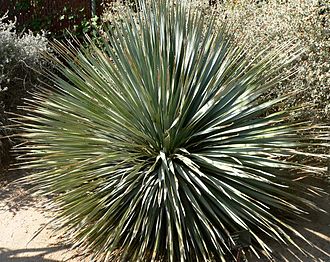
The flowering stem grows above the foliage, to a height of 16 feet tall. The stem is topped by a long plume of straw-colored small flowers. The color of the flower determinate the gender of the plant, being mostly white colored for males and purple-pink for females.
It is grown as an ornamental plant, valued in xeriscaping. As it does not tolerate extended frosts, in temperate regions it is usually grown under glass. It has gained the Royal Horticultural Society's Award of Garden Merit.
The alcoholic drink sotol, the northern cousin to tequila and mezcal, is made from the fermented inner cores of the desert spoon. It is the state drink of the Mexican states of Chihuahua, Durango, and Coahuila.
It was also used by the natives of the region for food and fiber. Its flower stalk can be used as a fire plow.
Cold hardy to 10 degrees.
The Tarahumara and Pima Bajo peoples of the Sierra Madre Occidental of Chihuahua weave baskets from the leaves after they strip off the spines from the leaf margins. They also employ the expanded leaf bases in making large artificial flowers as holiday decorations.

Contact Us | Privacy Policy | About Us
Serving gardeners since 1992
State of Mississippi Seedmen's Permit #C-391, Ohio 90152, Minnesota 20086777